Ame-no-Torifune in the Record: Kojiki and Nihon Shoki Anchors
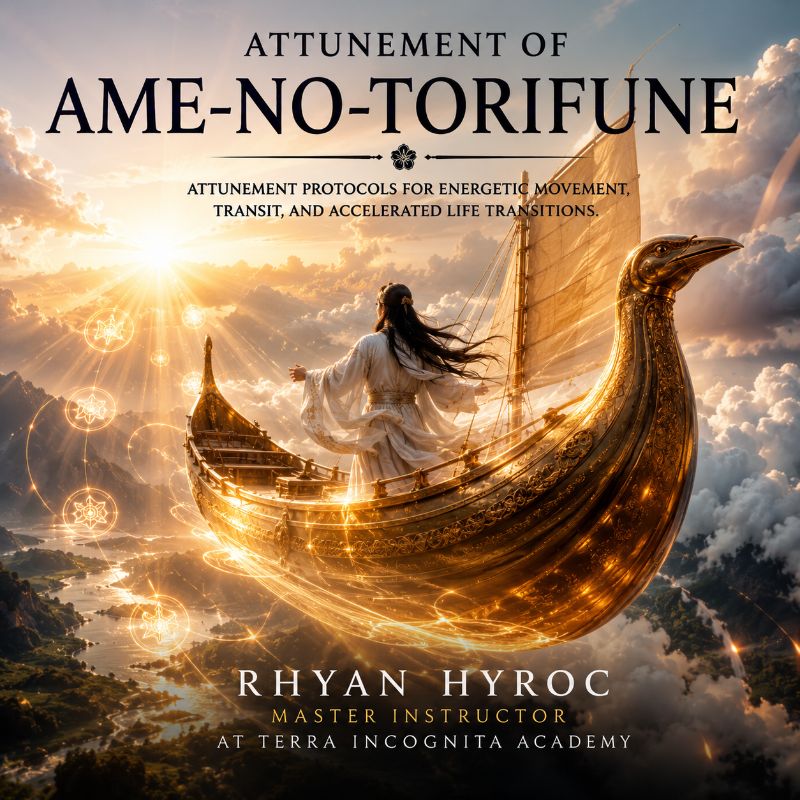
Course: Attunement of Ame-no-Torifune
Module: Grounds of Ame-no-Torifune: Cosmology, Symbol, and Scope
Instructor: T.I. Team
🔓 Free Preview Lesson
Learning Intent
You will establish a precise working frame for ame-no-torifune attunement by anchoring practice in the canonical cosmology of the Kojiki and Nihon Shoki. We will extract operational themes—movement, conveyance, threshold, and coordinated divine assistance—from the passages that describe celestial transport and descent. Your aim is to convert mythic motifs into reliable energetic operators without importing later folk accretions or unrelated systems.
By the end of this lesson you will be able to articulate a clear, practice-ready definition of Ame-no-Torifune as a kami-function: the disciplined alignment of body-mind with benevolent conveyance, enabling safe transition across states, spaces, and roles. You will distinguish core textual features (ascent, descent, divine escort, and threshold crossing) from later narrative embroidery, and you will adopt the proper technical language to work coherently with kami who teach movement.
Tradition Grounding
This course is rooted in Shinto cosmology; the Kojiki and Nihon Shoki provide our primary anchors for the celestial transport complex to which Ame-no-Torifune belongs. To situate our method within a broader history of occult technique, it is useful to note that mature traditions consistently extract operational principles from mythic narrative. The Picatrix (Ghayat al-Hakim) demonstrates how symbolic correspondences are systematized into workable operations, while the Arbatel (paired historically with the Heptameron) emphasizes dignified, ethical cooperation with intelligences for practical aims. We do not adopt their systems here; rather, we acknowledge a shared methodological rigor: (1) read the canonical record, (2) isolate stable symbols, (3) define a clean operative scope, and (4) engage cooperative spirits with clarity and respect.
Applied to Shinto practice, this means we approach Ame-no-Torifune as a benevolent teacher of movement whose function is encoded