Ishikori-dome in Classical Sources: Function, Lineage, and Mirror-Craft
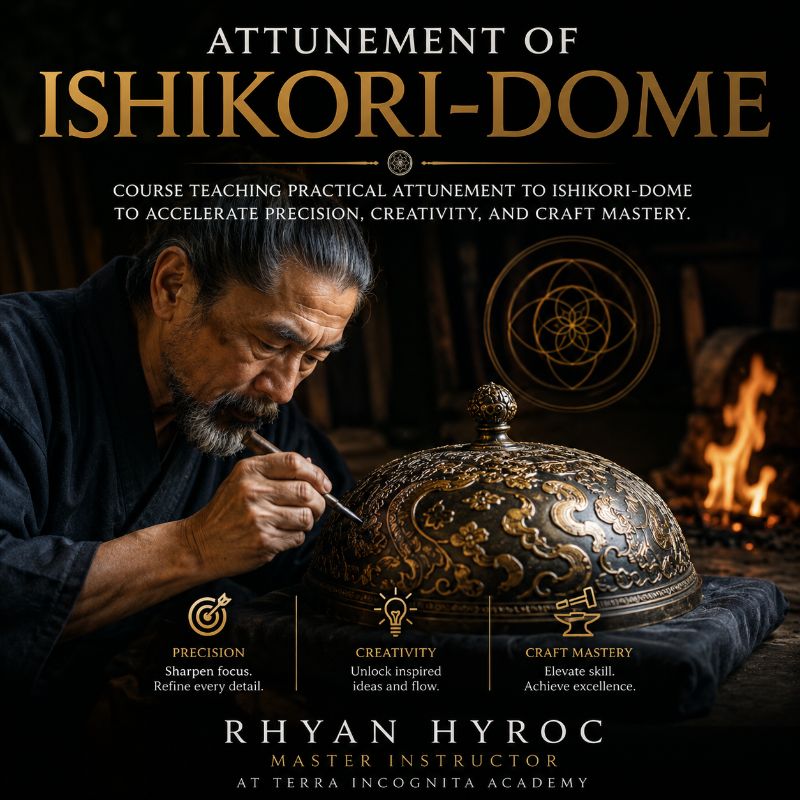
Course: Attunement of Ishikori-dome
Module: Foundations of Ishikori-dome Attunement: History, Ethos, and Craft Orientation
Instructor: T.I. Team
🔓 Free Preview Lesson
Learning Intent
This lesson establishes an authoritative orientation to Ishikori-dome as a benevolent craft-intelligence whose historical functions in mirror-making define a rigorous model for precision, calibration, and perceptual accuracy. You will extract method from source, not myth from modern projection. We will read Ishikori-dome’s role as an engineering brief: how a mirror is conceived, forged, ground, and polished until it renders surface truth without distortion—and how that process becomes a transferable discipline for any specialized craft.
By the end of this lesson you will be able to summarize Ishikori-dome’s appearances in the Kojiki and Nihon Shoki, identify her network of allied craft kami, and articulate mirror-craft as a concrete template for achieving tolerance, finish, and fidelity in your work. You will distinguish verifiable historical functions from later embellishments, and you will set the first parameters for your own kagami-based calibration practice.
Tradition Grounding
Primary Japanese sources: the Kojiki (Record of Ancient Matters, 712 CE) and the Nihon Shoki (Chronicles of Japan, 720 CE) preserve multiple accounts of the crisis of concealment and restoration of order involving Amaterasu-ōmikami. In these, Ishikori-dome-no-Mikoto is credited with the technical and ritual act of fabricating the mirror that restores sight and alignment. The mirror becomes one of the Imperial Regalia (Yata no Kagami), signifying truth and proper reflection.
Comparative historical references for method, not for adoption: the Picatrix (Ghayat al-Hakim) treats the disciplining of perception and image-making as precision craft—its instructions on purifying the imaginative “mirror” parallel the Japanese insistence on accurate reflection through finish and alignment. Within the broader Kabbalah & Hermetic Tradition, the “spec