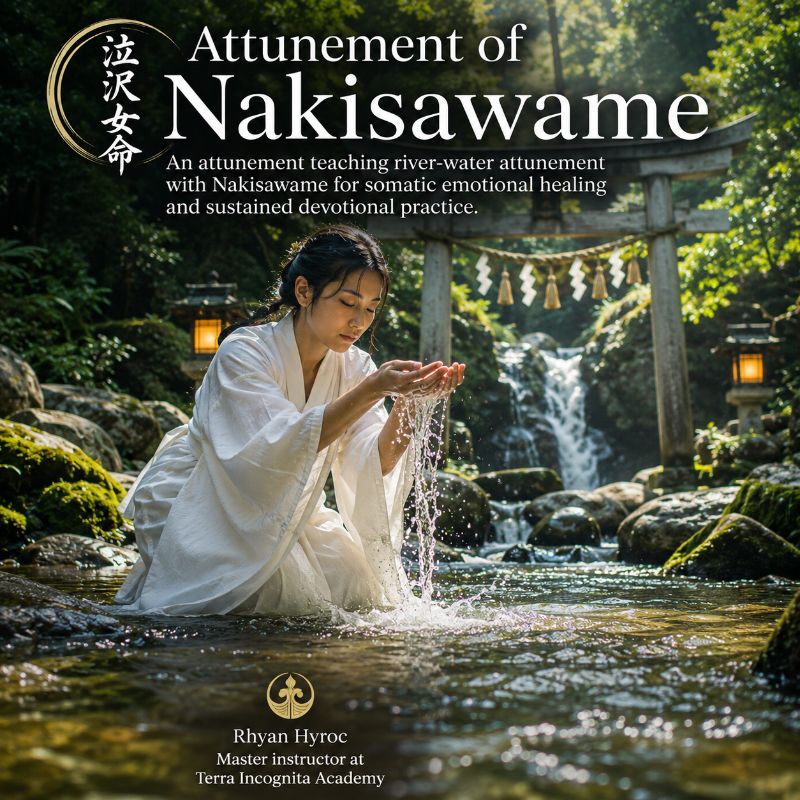
Module: Foundations of Nakisawame: Text, Context, and Ethical Grounding
Instructor:T.I. Team
🔓 Free Preview Lesson
Learning Intent
You will establish an exacting baseline for the name, attributes, and roles signified by nakisawame and place this intelligence within the documented ecology of river-oriented Shinto practice. We will distinguish what is explicitly attested in classical literature from what is inferred or carried forward in shrine life and living cult. This clarity prevents projection and creates the conditions for disciplined relationship-building with the benevolent river-teacher we invoke under the devotional title “nakisawame.”
By the end of this lesson, you will be able to cite the core purification passages in the Kojiki and Nihon Shoki that anchor water-based cleansing and emotional unburdening, understand how scholars such as Hardacre and Breen & Teeuwen read these passages within ritual history, and articulate a precise working definition of nakisawame suitable for contemporary, ethical practice. Your definition will be operational: clear enough to guide invocation, attunement, and journaling without fictionalization or cultural drift.
Tradition Grounding
Our framework is practical Shinto-informed watercraft, grounded in primary Japanese sources: the Kojiki (712) and the Nihon Shoki (720), together with the Great Purification prayer (Ōharae no norito) and shrine-ritual histories analyzed by Helen Hardacre (Shinto: A History) and John Breen & Mark Teeuwen (A New History of Shinto). These sources attest the centrality of misogi (ablution) at river mouths and rapids, the doctrine of harai/kegare (purification/impurity), and the personhood of river rapids deities invoked to carry away affliction.
To clarify scope, our work does not employ Western ceremonial frameworks. References such as Picatrix and the Ars Notoria are acknowledged here solely to demarcate boundaries: they are not our models. This co