Zao Gongen: Historical Emergence and Role in Mountain Practice
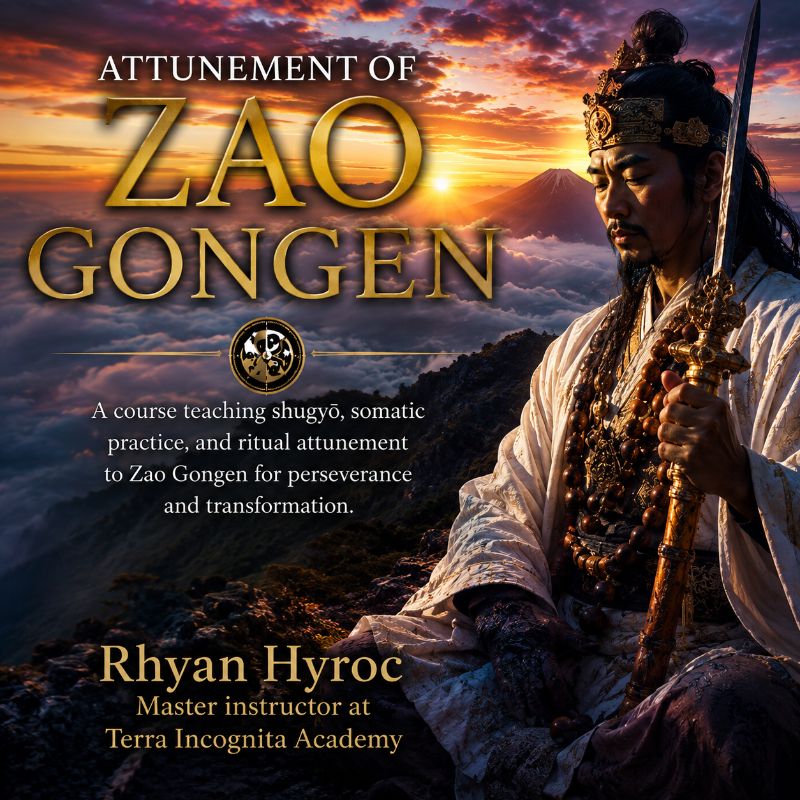
Course: Attunement of Zao Gongen
Module: Foundations of Zao Gongen Attunement: History, Iconography, and Ethical Grounding
Instructor: T.I. Team
🔓 Free Preview Lesson
Learning Intent
By the end of this lesson, you will possess a historically grounded understanding of Zao Gongen’s emergence within Shugendō, the mountain ascetic stream that integrates praxis from early esoteric Buddhism, local kami veneration, and courtly ritual. You will identify the cultic centers, especially Kinpusen and the Ōmine range, recognize Zao’s principal iconographic features, and understand how these inform disciplined practice and ethical relationship with mountain-origin guidance.
You will also understand the gongen concept as a doctrinal and practical key: an “avatar” or “manifest trace” through which enlightened compassion takes a form suitable to guide practitioners through thresholds of perseverance and transformation. This competence is the baseline for precise zao gongen attunement in later modules: you will read images, sites, and narratives as instructional maps, not projections, and approach the mountain as a cooperative teacher whose strength is offered for your maturation.
Tradition Grounding
Our work is situated in Japanese mountain asceticism and is not derived from European ceremonial literature. However, responsible scholarship recognizes adjacent corpora to clarify method. Two examples: the Picatrix (Ghayat al-Hakim) and the Arbatel of Magic are Western compilations that codify cosmology, virtue-ethics, and ritual sequencing. We cite them only to show that serious traditions worldwide: (1) bind practice to ethical cultivation; (2) sequence rites from purification to contact; and (3) value intermediaries as cooperative intelligences. In this course we do not adopt their frameworks; we rely on Shugendō-informed sources and mountain praxis.
The comparison illuminates a methodological constant: carefully defined terms, disciplined preparation, and reciprocal ethos. With that standa