Control the Ritual, Control the Risk
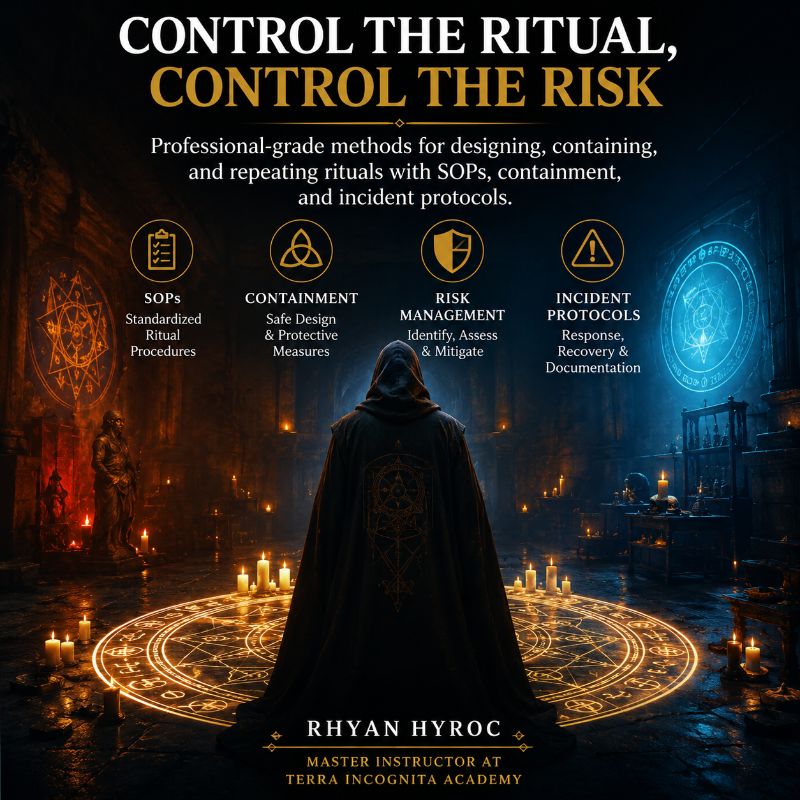
This course teaches repeatable, auditable ritual practice focused on risk control, containment, and procedural discipline. It is designed for intermediate practitioners who already perform basic ritual work and now require professional-grade preparation and operational reliability. The curriculum translates historical procedural models — liturgical rubrics, Renaissance ceremonial checklists, and temple-order operational discipline — into modern SOPs, containment strategies, and incident protocols that produce consistent outcomes. Participants will learn systematic hazard scanning (environmental, procedural, psychological), structure-first ritual design (intent statements, sequence maps, roles, timing and checkpoints), and physical and attentional containment techniques. The course provides templates: pre-ritual checklists, scene maps, attention-control scripts, redundancy matrices, and stop-condition flowcharts. Emphasis is placed on error prevention and controlled recovery: defined failure modes, explicit abort conditions, staged interruption barriers, and recovery SOPs with de-escalation steps. Operational stability methods cover state regulation (pacing, breath and attention bandwidth management, fatigue control), procedural cadence, and instrumentation for verification and repeatability (variables, controls, calibration routines, and post-ritual verification logs). Spirits are presented as cooperative, intelligent partners whose role is framed and managed through clear agreements, scope discipline, and escalation limits. The course concludes with incident response, aftercare, and ethical protocols: debrief templates, grounding procedures, integration practices, anomaly logging, and consent frameworks for collaborative work. Delivered as applied modules with SOPs, templates, and example logs, this course equips you to run controlled rituals reliably, respond to anomalies with clarity, and document outcomes for continuous improvement.
Instructor: T.I. Team
Level: intermediate
Duration: 8 weeks
Price: €49
Course Curriculum
Module 1 — Foundations of Ritual Risk Control: Structure, Hazards, and Baselines
- 1.1 — The Operator’s Contract: Control the Ritual, Control the Risk
- 1.2 — Pre-Ritual Hazard Scanning: Environment, Procedure, and Psychology
- 1.3 — Ritual as a Controlled Process: Variables, Constraints, and Checkpoints
- 1.4 — SOPs and Checklists: From Memory-Based to Procedure-Based Practice
- 1.5 — Containment Basics I: Space Control and Interruption Barriers
- 1.6 — Containment Basics II: Attention Control and Energy Containment
- 1.7 — Safe Abort Protocols: Stop Conditions Without Collapse
- 1.8 — Baseline Calibration: Measuring “Normal” to Detect Drift
Module 2 — Method and Discipline: Historical Procedure as Risk Control
- 2.1 — Liber O as Operations Manual: Ordered Practice and Verification
- 2.2 — Liber E and Bardon: Training as Risk Management Infrastructure
- 2.3 — Golden Dawn Temple Mechanics: Setup Discipline as Containment
- 2.4 — Constraint in the PGM: Precision, Conditions, and Operational Limits
- 2.5 — Paracelsus on Preparation: Method, Cleanliness, and Practical Discipline
- 2.6 — Failure Modes and Redundancy: Designing for Human Error
- 2.7 — Documentation That Works: Logs, Anomaly Records, and Version Control
- 2.8 — Ethics as Control: Consent, Scope Discipline, and Escalation Limits
Module 3 — Energetic Preparation and Operational Stability: State, Bandwidth, and Containment
- 3.1 — State Regulation Stack: Breath, Posture, Attention, and Timing
- 3.2 — Bandwidth Management: Preventing Overreach and Ritual Sprawl
- 3.3 — Containment Layering: Perimeter, Threshold, Core
- 3.4 — Procedural Open/Close: Clean Start, Clean Finish, Clean Record
- 3.5 — Interruptions and Noise: Designing for Real-World Conditions
- 3.6 — Recovery Engineering: Grounding, Cleanup, and Integration
- 3.7 — Anomaly Triage: Classification, Response, and Follow-Up
- 3.8 — Verification Discipline: Post-Ritual Checks and Outcome Alignment
Module 4 — Spirit Relationships as Controlled Partnership: Operational Mastery and Integration
- 4.1 — Spirits as Cooperative Professionals: Relationship Rules that Create Stability
- 4.2 — Communication Protocols: Signal Clarity, Confirmation, and Limits
- 4.3 — Request Engineering: Writing Intent, Scope, Deliverables, and Timing
- 4.4 — Containment with Partnership: Boundaries that Support Cooperation
- 4.5 — Controlled Operations: End-to-End Execution with Checkpoints
- 4.6 — Incident Response in Spirit Work: Calm Protocols and Clean Restoration
- 4.7 — Integration and Review: Turning Results into Reliable Capacity
- 4.8 — Mastery Plan: Personal Risk Register, Quarterly Audits, and Scaling Complexity