Align Spiritual Work with Real-World Results
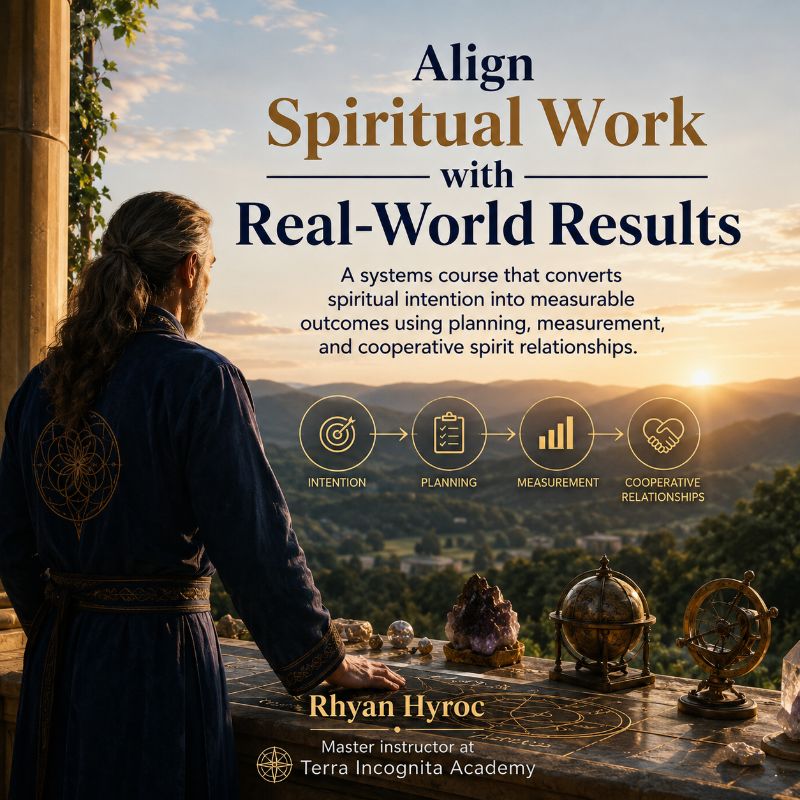
This course trains intermediate practitioners to convert spiritual intention into measurable, verifiable life outcomes. It combines operational planning, evaluation science, and ethically framed cooperative spirit work so your practice produces repeatable results without sacrificing depth. Across four modules you will learn to define success operationally, select and prioritize goals by values and constraints, construct practice plans with inputs, cadence, sequencing and effort budgets, and link those practices directly to daily behavior. You will receive specific protocols for journaling, leading and lagging indicators, review cycles, hypothesis testing and rules for adjustment. Module 3 presents a pragmatic, ethically grounded approach to spirit relationships: how to cultivate cooperative, consenting guides as allies in development, how to calibrate requests, and how to verify their contribution through measurement. All spirits are framed as intelligent, benevolent collaborators whose guidance is tested via outcome metrics rather than belief alone. The course emphasizes corrective protocols for common failure modes — wishful thinking, spiritual bypass, inconsistency, and scope creep — with clear steps to recover momentum. Ethics and responsibility are integrated throughout: consent, impact assessment, transparency, and sustainability are required constraints on any practice designed for results. Students finish with a concrete, reusable practice playbook: goal definitions, prioritized plans, daily integration templates, evaluation dashboards, and an iterative rule-set for long-term refinement. No guarantees are offered; instead you gain replicable methods to test, measure, and refine your work.
Instructor: T.I. Team
Level: everybody
Duration: 8 weeks
Price: €39
Course Curriculum
Module 1 — Defining Spiritual Goal Alignment in Measurable Terms
- 1.1 Operational Definition: From Intention to Outcome
- 1.2 Values, Virtue, and Practical Reason as Goal Filters
- 1.3 Prioritization Under Constraint: One Aim, Few Metrics
- 1.4 Outcome Models: Leading vs. Lagging Indicators
- 1.5 The Evidence Standard: Fruits, Not Stories
- 1.6 The Practice Contract: Inputs, Cadence, and Minimum Effective Dose
- 1.7 Failure Modes I: Wishful Thinking and Spiritual Bypassing
- 1.8 Ethics Baseline: Consent, Impact, and Sustainability
Module 2 — Structured Review, Discernment, and Iterative Practice Design
- 2.1 The Weekly Review: A Minimal, Non-Negotiable Loop
- 2.2 Monthly and Quarterly Reviews: Drucker-Style Effectiveness
- 2.3 Discernment of Movements: A Structured Method for Decision Clarity
- 2.4 Hypothesis Testing: Treat Practice as Inquiry (Dewey)
- 2.5 Habit Architecture: Converting Spiritual Aims into Daily Conduct
- 2.6 Failure Modes II: Inconsistency, Scope Creep, and Plan Abandonment
- 2.7 Ethics in Action: Integrity as a Measurable Outcome
- 2.8 Personal Operating System: Your Alignment Dashboard
Module 3 — Energetic Readiness and Cooperative Spirit Relationships for Results
- 3.1 Readiness Baseline: Attention, Energy, and Emotional Bandwidth
- 3.2 Energetic Budgeting: Effort Allocation Without Overreach
- 3.3 Ethical Container for Spirit Cooperation: Consent, Clarity, and Impact
- 3.4 Contact Protocol: Structured Invitation and Clear Terms
- 3.5 Discernment with Spirits: Verification Without Paranoia
- 3.6 Spirit Support for Habit Change: Translating Guidance into Conduct
- 3.7 Failure Modes III: Dependency, Inflation, and Avoidance of Agency
- 3.8 Building a Cooperative Network: Matching Allies to Outcomes
Module 4 — Practical Ritualization, Integration, and Mastery of Alignment
- 4.1 The Practical Operation: A Repeatable Template
- 4.2 Sequencing: When to Act, When to Reflect, When to Ask for Help
- 4.3 Micro-Rituals for Daily Alignment: Habits, Speech, and Attention
- 4.4 Spirit-Assisted Operations: Requests That Produce Verifiable Change
- 4.5 Closing the Loop: Review Cycles That Produce Upgrades
- 4.6 Plateau Diagnostics: When Results Stall
- 4.7 Integration Across Life Domains: Relationships, Work, and Community
- 4.8 Mastery Plan: Long-Horizon Alignment and Continuous Formation