Attunement of Futodama
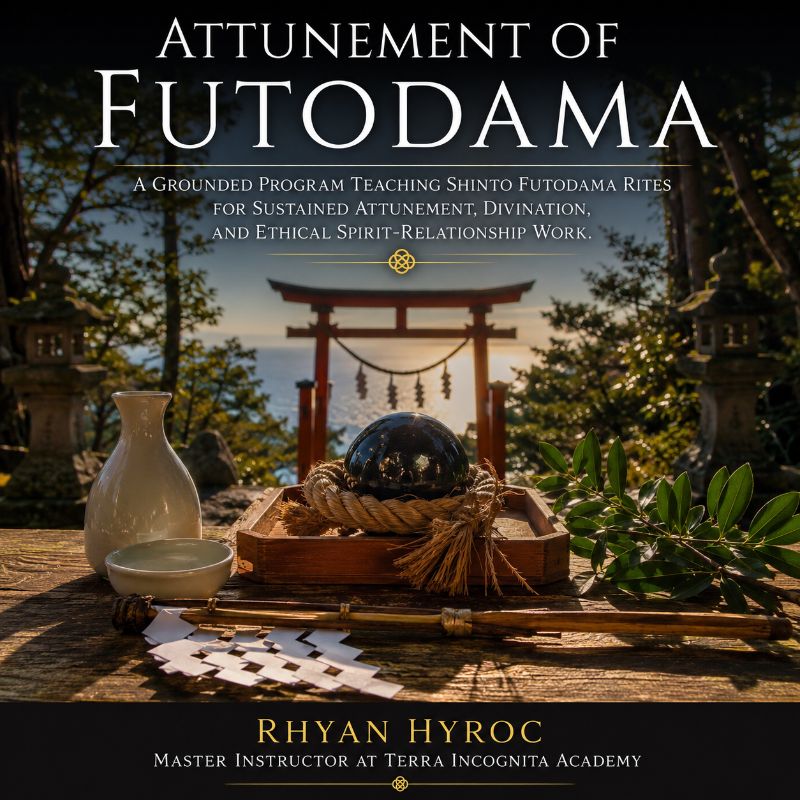
This course presents a disciplined, historically-grounded pathway to attunement with Futodama—the classical Shinto ritual specialist and ancestral guide recorded in the Kojiki, Nihon Shoki, and regulated in Engishiki. It is designed for intermediate practitioners with existing ritual or meditative experience who seek precise methods to increase intuitive clarity, ritual efficacy, and a sustained, reciprocal relationship with benevolent spirit‑guides. Instruction emphasizes original source patterns and practical adaptation: preparatory purification (harae, misogi miniatures), focused offering protocols, norito phrasing adapted for attunement, and a stepwise consecration sequence that preserves classical form while remaining safe for contemporary practice. Somatic centering, breath metrics, and attention protocols are taught as reproducible skills rather than ad hoc techniques. Practical divinatory practices—dream incubation, active imagination logs, and calibrated inquiry sessions—are linked directly to Futodama rites so perceptual gains are verifiable and repeatable. Course modules cover ritual space design (boundary lines, shimenawa, sakaki placement, mirror/taima handling), implement maintenance, and group attunement formats. An ethical framework is central: continuity, explicit consent, calibrated reciprocity, and clear aftercare. Advanced sessions address calibrated offerings for different outcomes, group facilitation, and troubleshooting diminished efficacy with concrete corrective steps. All spirits are presented as cooperative teachers and initiators; this training teaches relationship, protocol, and craft so practitioners gain reliable skill rather than speculative belief.
Instructor: T.I. Team
Level: everybody
Duration: 8 weeks
Price: €55
Course Curriculum
Classical Foundations of Futodama Attunement
- Futodama in the Classical Record: Role, Functions, and Lineage
- Kojiki and Nihon Shoki: The Iwato Operation and Ritual Actions
- Engishiki Norito and the Imbe Mandate: Court Ritual Precedents
- Ritual Implements in Futodama Work: Gohei, Shimenawa, Sakaki, Shaku
- Offerings and Norito as Mediation Technologies
- Reciprocity and Consent in Classical Practice
- Profile of Benevolent Mediation: Working With Kami as Teachers
- Course Map and Competency Benchmarks for Attunement of Futodama
Energetic Preparation and Mediation Skills for Futodama Attunement
- Purification: Misogi, Harae, and Daily Cleanliness for Attunement
- Breath Patterns and Somatic Centering: Ibuki for Ritual Stability
- Focused Offerings: Rice, Salt, Water, Sakaki—Composition and Timing
- Norito for Futodama: Structure, Phrasing, and Diction
- Consecration Sequence: Boundary-Setting, Gohei Consecration, and Field Stabilization
- Attentional Control: Fixed Gaze, Auditory Silence, and Tactile Awareness
- Codes of Reciprocity: Petition, Acknowledgment, and Offer-Return Cycles
- Markers of Contact and Attunement: Perceptual Signatures and Logging
Ritual Space, Full Attunement, and Divinatory Applications
- Ritual Space Design: Orientation, Altars, and Maintenance
- Full Attunement Session: Minute-by-Minute Protocol
- Dream Incubation under Futodama’s Patronage
- Active Imagination Logs and Symbol Lexicon Development
- Divinatory Practice Linked to Futodama Rites: Lot-Casting and Omen-Reading
- Group Attunement Facilitation: Roles, Sequences, and Debrief
- Troubleshooting Diminished Efficacy: Diagnostics and Corrections
- Maintaining Efficacy: Cleaning Schedules, Offerings Rotation, and Space Audits
Integration, Ethics, and Mastery: Sustained Relationship with Futodama
- Daily Integration: Embodiment Drills, Aftercare, and Skill Retention
- Ethical Relationship Maintenance with Benevolent Guides
- Calibrated Offerings for Distinct Outcomes: Clarity, Protection, Guidance
- Seasonal and Calendrical Alignment for Futodama Work
- Leading Households and Small Groups in Futodama Rites
- Advanced Perception Training: Multimodal Sensing and Signal Discrimination
- Long-term Journaling Protocols and Data Review
- Capstone: Personal Attunement Dossier and Ongoing Plan