Attunement of Tsukuyomi
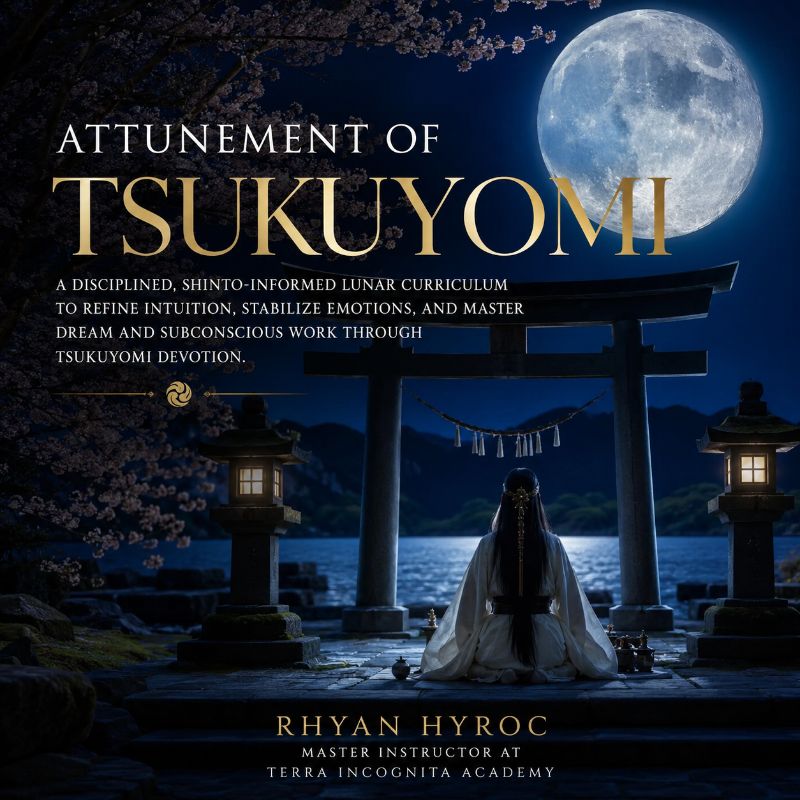
This course is a practical, discipline-centered training in tsukuyomi attunement: a Shinto-informed devotional path that uses moon-phase timing, verified perception protocols, and structured dreamwork to refine intuition and stabilize emotional life. Students will develop reliable psychic hygiene, measurable signal-vs-noise calibration methods, and a repeatable monthly practice aligned with new, waxing, full, waning, and dark moon phases. Instruction is technical and practice-focused. You will receive exact protocols for dream incubation and recall, journal formats for verification, step-by-step meditation sequences for stillness and attention control, and specific techniques for subconscious re-scripting and habit reconditioning. Devotional work with Tsukuyomi is presented as a cooperative, benevolent relationship: altar protocol, appropriate offerings, prayers, and etiquette tailored to Japanese Shinto forms and historical precedent are taught with ethical boundaries and cultural care. The curriculum avoids unrelated ceremonial systems and adversarial spirit frameworks. Instead, it relies on documented Shinto devotional practice, classical dream incubation techniques, modern verification methods, and established subtle-perception training. By course end you will have a personalized lunar-symbol lexicon, calibrated perception checks, and an integrated monthly practice that produces measurable improvements in intuition, emotional regulation, dream integration, and subconscious mastery.
Instructor: T.I. Team
Level: everybody
Duration: 12 weeks (3 lunar cycles)
Price: €55
Course Curriculum
Module 1 — Foundations of Tsukuyomi Attunement and Lunar Discipline
- 1.1 — What Tsukuyomi Attunement Is (and How You’ll Measure It)
- 1.2 — Tsukuyomi in the Kojiki and Nihon Shoki: Myth as Practice-Instruction
- 1.3 — Norito Form: Prayer as Attention-Training and Relationship Protocol
- 1.4 — Altar Protocol and Offerings: Clean Simplicity, Consistent Results
- 1.5 — Moon-Phase Structure I: New Moon and Waxing Moon Training Plan
- 1.6 — Meditation for Lunar Stillness: Attention Control and Contemplative Inquiry
- 1.7 — Dream Recall Baseline: Capture, Tagging, and Minimal Interpretation
- 1.8 — Building Your Personal Lunar Symbol Lexicon (Without Guesswork)
Module 2 — Theory, History, and Verification: Making Lunar Perception Reliable
- 2.1 — Moon-Phase Structure II: Full Moon, Waning, and Dark Moon Protocols
- 2.2 — Signal vs Noise: Calibration Drills for Intuition
- 2.3 — Emotional Literacy via The Tale of Genji: Observation Without Drama
- 2.4 — Night Contemplation via The Pillow Book: Training Sensitivity to Lunar Cues
- 2.5 — Dream Incubation: Questions That Produce Useful Dreams
- 2.6 — Dream Interpretation Frameworks: Layering Meaning Without Projection
- 2.7 — Optional Lunar Support: Minimal Astronomy and Non-Dominant Astrology Use
- 2.8 — Building the Practitioner’s Journal: Templates for Evidence, Not Poetry
Module 3 — Energetic Preparation, Boundaries, and Subconscious Conditioning
- 3.1 — Perceptual Hygiene: Boundaries That Increase Sensitivity
- 3.2 — Clair Channels as Cognitive-Sensory Skills: Training Without Fantasy
- 3.3 — Emotional Regulation by Phase: Regulation, Reflection, Decompression
- 3.4 — Shadow Pattern Recognition: Identifying the Subconscious Lunar Knot
- 3.5 — Re-scripting: Dream-to-Waking Behavioral Recode
- 3.6 — Habit Reconditioning: Lunar Micro-Commitments That Stick
- 3.7 — Dream Hygiene: Sleep, Diet, Media, and the Subtle Field
- 3.8 — Advanced Symbol Lexicon: Cross-Referencing Dreams, Mood, and Moonlight
Module 4 — Devotional Relationship, Ritual Practice, and Integration Mastery
- 4.1 — Relationship Governance: Etiquette, Consent, and Clarity with Kami
- 4.2 — Monthly Tsukuyomi Devotional Cycle: A Complete Liturgical Practice Plan
- 4.3 — Full Moon Rite: Illumination, Confirmation, and Truth Without Excess
- 4.4 — Waning Moon Rite: Release, Forgiveness, and Emotional Decompression
- 4.5 — Dark Moon Practice: Quiet Listening and Subconscious Re-Alignment
- 4.6 — Dream Consultation with Tsukuyomi: A Responsible Request-and-Response Method
- 4.7 — Subtle Perception in Daily Life: Micro-Readings and Ethical Use
- 4.8 — Mastery Integration: The 90-Day Tsukuyomi Attunement Continuation Plan