Balance Light and Dark for Maximum Control
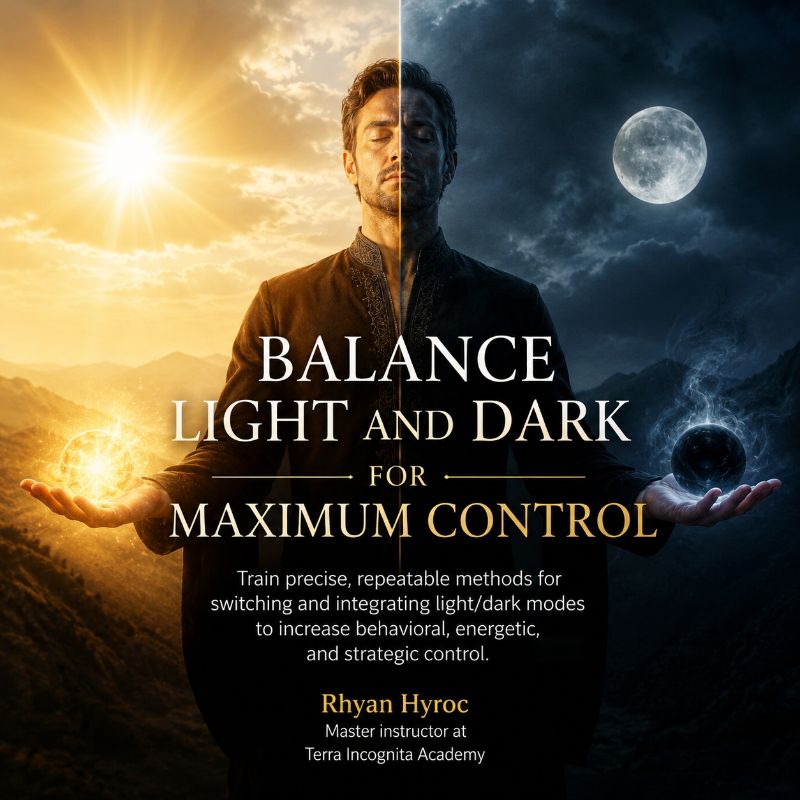
This course provides a rigorous, practice-first curriculum for intermediate occult practitioners who require reliable control over internal modes framed as functional “light” and “dark” states. Rather than moral binaries, light and dark are defined operationally as ensembles of cognition, arousal, posture, and influence strategies. You will be given mapping tools, decision rules, and safety protocols to switch states without drift, deploy constructive or disruptive force with calibrated intent, and integrate shadow material into everyday governance. Course content is drawn from lineage-informed practical occultism and applied inner development: polarity continuum models, reconciliation procedures, state-switch protocols, arousal regulation techniques, and aftercare systems. Each module contains clear procedures, audit templates, and situational playbooks for real-world application—negotiation, boundary enforcement, leadership, creative destruction, and relational repair. Emphasis is on reproducible methods: how to set the signal for a state, how to test fidelity, how to decouple habit responses, and how to restore baseline without confusion. Risk management is built into every lesson. You will learn pacing, boundary templates, centering and grounding routines, and ethical governance measures that ensure shadow integration functions as a control mechanism rather than an impulsive release. By course end you will hold a stable core intent that permits high situational flexibility while maintaining internal coherence and clear feedback loops.
Instructor: T.I. Team
Level: intermediate
Duration: 8 weeks
Price: €29
Course Curriculum
Module 1 — Functional Polarity: Definitions, Maps, and Control Targets
- 1.1 Operational Definitions: Light and Dark as Modes, Not Morals
- 1.2 Polarity Mapping I: Axes, Continua, and Context Variables
- 1.3 Shadow as Signal: Jungian Shadow for Control, Not Confession
- 1.4 Enantiodromia and Reversal: Predicting Polarity Snap-Back
- 1.5 Stoic Control Frame: What Is Yours to Govern, What Is Not
- 1.6 Decision Rules I: Mode Selection by Outcome and Cost
- 1.7 Drift Signals: Confusion, Inflations, and Moral Substitution
- 1.8 Baseline Self-Audit: Metrics for Polarity Control
Module 2 — Frameworks and Switching: Reconciliation, Strategy, and Ethical Governance
- 2.1 Yin–Yang Mechanics: Reciprocity, Mutual Containment, and Timing
- 2.2 Reconciliation Methods I: Third Position, Synthesis, and Sequencing
- 2.3 Crowley’s Practice Structure: Discipline, Record, and the Training of Will
- 2.4 Switching Protocol I: State Entry, State Exit, and Clean Handoffs
- 2.5 Ethical Self-Governance: Constraint Systems That Prevent Self-Excuse
- 2.6 Controlled Disruption: Cutting, Pruning, and Boundary Enforcement
- 2.7 Constructive Force: Repair, Nourishment, and Coherence Building
- 2.8 Feedback Loops II: Review Cycles, Error Correction, and Calibration
Module 3 — Regulation and Energetic Hygiene: Building the Stable Core
- 3.1 Arousal Control: Turning Intensity Up or Down on Command
- 3.2 Grounding Methods: Load-Bearing Stability in the Body
- 3.3 Centering and Alignment: Regardie-Inspired Internal Coherence
- 3.4 Hygiene of Influence: Fortune-Style Boundaries Without Paranoia
- 3.5 Containment: Holding Shadow Material Without Acting It Out
- 3.6 Pacing and Load Management: Avoiding Overextension
- 3.7 Aftercare Protocols: Restoring Clarity After Disruption or Repair
- 3.8 Regulation Under Social Pressure: Maintaining Core Intent in the Field
Module 4 — Integration and Mastery: Advanced Application, Risk Controls, and Long-Term Stability
- 4.1 Integration Architecture: One Intent, Two Modes, Many Expressions
- 4.2 Advanced Switching: Rapid Cycling Without Fragmentation
- 4.3 Strategic Application: Build, Break, Bind, Release
- 4.4 Shadow Integration II: Converting Triggers into Capabilities
- 4.5 Ethics Under Power: Preventing Corruption, Self-Betrayal, and Drift
- 4.6 Risk Management II: Boundaries, Social Fallout, and Recovery Planning
- 4.7 Integration in Complex Systems: Work, Relationships, and Long Horizons
- 4.8 Capstone Operating System: Your Polarity Manual and Maintenance Cycle