Breathe Your Way Into Power States
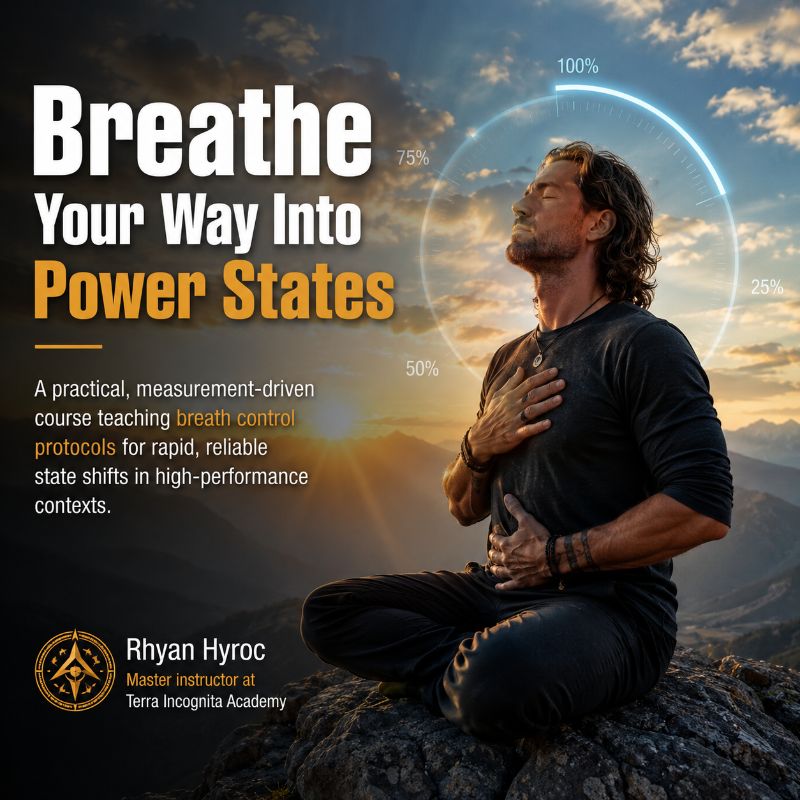
This course trains intermediate practitioners in precise, repeatable breath control methods for on‑demand shifts: focus, calm alertness, drive, and recovery. Grounded in respiratory mechanics, autonomic physiology, and classical pranayama frameworks adapted for performance, the curriculum emphasizes timed patterns, measurable markers, safety stop rules, and individualized protocol design. Module 1 establishes clear baselines: diaphragm versus accessory breathing, rib‑cage dynamics, nasal breathing mechanics, posture corrections, and simple CO2 tolerance self‑tests. Stop rules, contraindications (dizziness, asthma/COPD flags, panic responses), and objective measurement practices (pulse checks, tremor observation, attention tasks) are taught before any activation work. Module 2 presents the physiological rationale: autonomic logic of breath, chemoreceptor responses, oxygen/CO2 balance, and the practical use of pranayama ratios and holds. No theatrical or ceremonial frameworks are used—just historically grounded, physiologically coherent protocols you can measure and repeat. Module 3 focuses on integrating breath with attention and sensory control: gaze, micro‑relaxation, internal dialogue, and body scanning to convert respiratory shifts into reliable cognitive and somatic outcomes. You will practice rapid activation sequences and learn metric‑driven troubleshooting when a pattern fails. Module 4 covers in‑the‑moment deployment for high‑stakes tasks, recovery sequences, maintenance cycles, and personalization strategies for durable results. The course explicitly excludes hyperventilation marathons, psychedelic breathwork, and unstructured intuitive breathing. Participants leave with a toolkit of timed patterns, safety rules, testing procedures, and a simple protocol design workflow for ongoing adaptation.
Instructor: T.I. Team
Level: everybody
Duration: 6 weeks
Price: €39
Course Curriculum
Module 1 — Foundations of Breath Control: Mechanics, Baselines, and Stop Rules
- 1.1 Respiratory Mechanics for Control: Diaphragm, Rib Cage, and Airway
- 1.2 Posture, Tongue, and Nasal Hygiene Variables (Non-medical) That Affect Cadence
- 1.3 Timing Fundamentals: Counts, Ratios, Holds, and Cadence Without Strain
- 1.4 Baseline Testing I: CO2 Tolerance and Comfort Thresholds
- 1.5 Baseline Testing II: Pulse Response, Tremor, and Attention Metrics
- 1.6 Safety Constraints: Stop Rules, Dizziness, Panic Signals, and Environment
- 1.7 Building Your First Protocol: The 10-Minute Baseline Session
- 1.8 Troubleshooting Mechanics and Timing: Common Failure Modes
Module 2 — Theory and Lineage: Why Breath Control Works (Physiology, Pranayama Frameworks, Autonomic Logic)
- 2.1 Respiratory Physiology for Practitioners: Ventilation, CO2, and the Urge-to-Breathe
- 2.2 Nasal Breathing as a Control Surface: Resistance, Cadence, and Attention Stability
- 2.3 Polyvagal Core Concepts for State Regulation (Non-therapeutic, Operational Use)
- 2.4 Pranayama as a Structured Technology: Ratios, Retention Types, and Progression Logic
- 2.5 Marker Literacy: Interpreting Pulse, Tremor, and Attention Without Guesswork
- 2.6 State Selection Logic: A Task-to-Pattern Decision Framework
- 2.7 Contraindications and Context Boundaries: Asthma/COPD Considerations and Conservative Options
- 2.8 Building Your Personal Pattern Library: Categorize, Name, and Log
Module 3 — Energetic Preparation Through Breath: Attention, Sensory Control, and Precision Readiness
- 3.1 Breath + Attention Coupling: Anchors, Counting Discipline, and Internal Dialogue Reduction
- 3.2 Gaze and Oculomotor Control: Stabilizing Arousal and Precision
- 3.3 Body Scanning and Micro-Relaxation: Removing Tension That Corrupts Breath Timing
- 3.4 Calm Alertness Protocol: Precision State for Decision and Fine Motor Control
- 3.5 Drive Protocol: Mobilization Without Agitation
- 3.6 Recovery Protocol: Fast Downshift and Post-Activation Reset
- 3.7 Stress Inoculation: Short Cycles Under Mild Pressure With Metrics
- 3.8 Personalization Sprint: Two-Week Adaptation Cycle and Troubleshooting
Module 4 — Integration and Mastery: High-Stakes Deployment, Maintenance, and On-Demand Switching
- 4.1 Rapid Switching: 30–90 Second On-Demand Shifts With Verification
- 4.2 Conflict and Social Composure: Breath Control Under Interpersonal Pressure
- 4.3 Performance Routines: Pre-Event Prime, In-Event Stabilize, Post-Event Reset
- 4.4 Precision Under Time Pressure: Short Decision Cycles and Breath-Based Cognitive Clearing
- 4.5 Maintenance Programming: Minimal Effective Dose, Deloads, and Recalibration
- 4.6 Sleep Support and Evening Downshift: Non-sedative Breath Timing
- 4.7 Troubleshooting Plateaus and Regressions: A Diagnostic Decision Tree
- 4.8 Capstone: Your Operational Breath Control System (Patterns, Triggers, Metrics, and Context Playbooks)