Build Your Own Oracle System
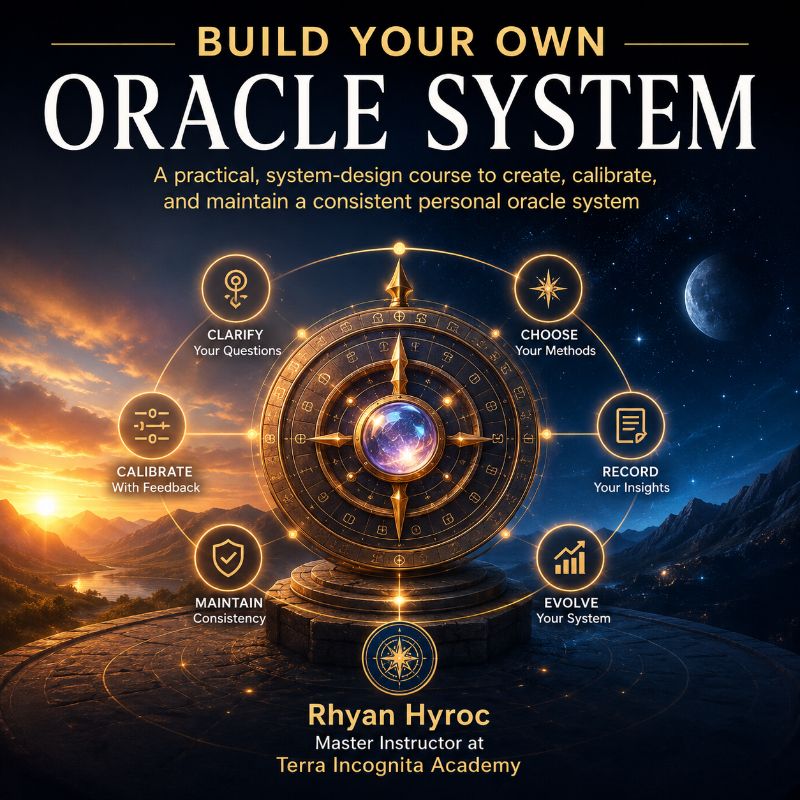
This course teaches an engineering-grade approach to building a personal oracle system: a controlled symbolic set, a deterministic engine, and a repeatable interpretation protocol that produces consistent guidance. You will design and document your own oracle so readings are reliable, auditable, and aligned with your decision-making needs. Modules cover symbolic mapping (how symbols encode meaning and how to construct a closed symbol set), system architecture (components, rules, and constraints), question design and input hygiene, interpretation protocol (step-by-step reading method and decision thresholds), consistency methods (calibration, validation, drift control), personal cognitive fit (tailoring mappings to thinking style and bias management), and record-keeping and iteration (journaling, version control, and refinement cycles). Practical workshops guide you through building the engine, running calibration tests, and conducting audits. The course is explicitly non-dependent on spirit contact: oracle accuracy is achieved through system design, validation, and operator discipline. Historical manuals and cross-cultural practices inform the methods; where non-human intelligences appear in tradition, they are treated as benevolent cultural constructs and optional allies — never required for the oracle to function. Ethical use, scope control, and preventing dependency are integral components. By course end you will own a documented, tested oracle system with audit trails and maintenance procedures suitable for decision-support within defined ethical boundaries.
Instructor: T.I. Team
Level: everybody
Duration: 8 weeks
Price: €35
Course Curriculum
Module 1 — Foundations: What an Oracle System Is (and Isn’t)
- 1.1 — Definition, Scope, and Success Criteria for an Oracle System
- 1.2 — Semiotics for Practitioners: Sign, Object, Interpretant
- 1.3 — Input Hygiene: Questions as Specifications
- 1.4 — Interpretation Protocol: From Output to Decision
- 1.5 — Bias Management I: Fast vs Slow Thinking in Readings
- 1.6 — Record-Keeping: The Oracle Journal as a Lab Notebook
- 1.7 — Output Design Basics: Clarity, Density, and Legibility
- 1.8 — Ethics and Scope Control: Dependency Prevention and Refusal Skills
Module 2 — Theory & Structure: Building the Symbol Set and Engine
- 2.1 — Controlled Symbol Sets: Semantics, Granularity, and Coverage
- 2.2 — Correspondence as Structure (Agrippa) Without Inheriting a Legacy Oracle
- 2.3 — The Oracle Engine: Randomization, Constraints, and Signal Weighting
- 2.4 — Interpretation Grammar: Syntax for Single and Composite Outputs
- 2.5 — Levi’s Discipline: Controlled Imagination and Interpretive Restraint
- 2.6 — Synchronicity as a Constraint Model (Jung), Not a License
- 2.7 — Validation I: Calibration Trials and Outcome Scoring
- 2.8 — Versioning the System: Releases, Change Logs, and Backward Compatibility
Module 3 — Preparation & Relationship: The Operator and the Oracle
- 3.1 — Operator Variables: Attention, Arousal, and Interpretive Noise
- 3.2 — Preparation Protocol: A Standardized Pre-Reading Sequence
- 3.3 — Bias Management II: Counter-Interpretations and Adversarial Read Passes
- 3.4 — Values Alignment: Encoding Ethics into Symbols and Rules
- 3.5 — Optional Spirit Relationships I: A Non-Compulsory Mentorship Model
- 3.6 — Optional Spirit Relationships II: Discernment, Verification, and Clean Attribution
- 3.7 — Tooling and Environment: Minimizing Noise in Physical and Digital Builds
- 3.8 — Dependency Prevention in Practice: Frequency Limits and Escalation Paths
Module 4 — Integration & Mastery: Operating, Auditing, and Evolving the Oracle System
- 4.1 — Validation II: Reliability, Repeatability, and Drift Detection
- 4.2 — Error Taxonomy: Classifying Failures to Fix Them
- 4.3 — Advanced Question Design: Multi-Constraint Queries and Tradeoffs
- 4.4 — Interpretation Under Uncertainty: Confidence Bands and Action Thresholds
- 4.5 — Refining the Symbol Set: Pruning, Merging, and Re-Defining
- 4.6 — Interface and Artifact Mastery: High-Integrity Output Design (Tufte)
- 4.7 — Ethics in Long-Term Use: Authority, Consent, and Reading for Others
- 4.8 — Capstone: Your Oracle System Specification and Operating Manual