Celestial Timing: Planetary Hours for Devotional Practice and Spirit-Work
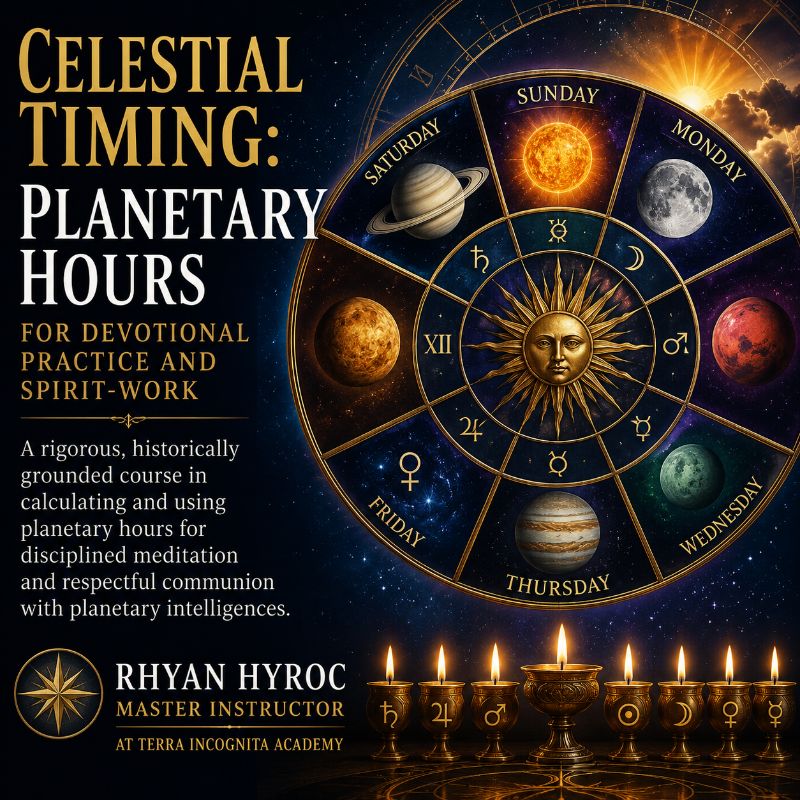
This course teaches precise, historically grounded methods for scheduling meditations and devotional spirit-work using planetary hours drawn from Solomonic and Renaissance timing doctrine. You will learn the Chaldean week structure, day rulers, and the operational use of planetary hours as an Ars Paulina timing key. The curriculum is practical: compute planetary hours for any latitude and season, choose hours suited to clarity, discipline, devotion, or contemplative inner work, and build a repeatable daily and weekly regimen without superstition or theatricality. Instruction integrates primary Renaissance sources (Ars Paulina, Heptameron, Arbatel) and Picatrix correspondences to give an actionable system of correspondences—virtues, temperaments, colors, metals, and sacred names—appropriate for contemplative practice. Emphasis is placed on respectful protocols: invitation and gratitude, clear boundaries, and ethical offerings as expressions of reciprocity. The course rejects predictive astrology, chaotic timing methods, and modern pop-cultural distortions; its purpose is skillful timing for spiritual formation and disciplined devotional work. Students will leave able to compute planetary hours using sunrise/sunset divisions, adjust for latitude and seasonal variance, map hour rulerships to specific meditative goals, and apply a robust protocol for preparation, opening, focus, closing, and record-keeping. Journaling, observation, and statistical validation methods are taught so practitioners refine timing hypotheses without confirmation bias. The tone is pedagogical and masterful: clear techniques from historical grimoire traditions, presented for safe, effective, and repeatable practice.
Instructor: T.I. Team
Level: beginner
Duration: 6 weeks
Price: €29
Course Curriculum
Module 1 — Foundations of Planetary Hours: Week, Order, and Daily Structure
- 1.1 The Chaldean Order and the Classical Planetary Week
- 1.2 Day Rulers vs. Hour Rulers: What Actually Governs a Practice Window
- 1.3 The 24-Hour Frame: Diurnal and Nocturnal Hours in Practice
- 1.4 Planetary Hours as a Devotional Scheduling Tool (Not Fortune-Telling)
- 1.5 Core Correspondence Vocabulary for Meditation: Virtue, Vice, Temperament
- 1.6 Minimal Tools: Timekeeping, Tables, and a Clean Record System
- 1.7 Building Your First Week: A Beginner-Strict Practice Schedule
Module 2 — History and Theory: Solomonic–Renaissance Timing Doctrine
- 2.1 Ars Paulina Timing Core: Hours as the Key to Planetary Angelic Governance
- 2.2 Heptameron: Days, Hours, and the Discipline of Ceremonial Structure
- 2.3 Arbatel: Planetary Virtues and the Cooperative Instruction of Olympic Spirits
- 2.4 Picatrix: Correspondence Logic and Timing Theory for Contemplative Use
- 2.5 Key of Solomon: Purity, Preparation, and Procedural Discipline
- 2.6 Sacred Names and Planetary Address: Precision Without Hype
- 2.7 A Coherent Model: How Timing, Correspondence, and Devotion Interlock
Module 3 — Calculation Mastery: Computing Planetary Hours Reliably
- 3.1 The Sunrise-to-Sunset Method: Definitions and Assumptions
- 3.2 Unequal Hours: Dividing Day and Night into Twelve
- 3.3 Seasonal Variability: What Changes and What Stays Stable
- 3.4 Latitude and Edge Cases: Long Days, Short Days, and Practical Adjustments
- 3.5 Verification: Auditing Tables, Apps, and Your Own Work
- 3.6 Choosing Hours for Specific Meditation Goals: A Strict Selection Method
- 3.7 Producing a Weekly Timing Dossier: Your Working Document
Module 4 — Relationship and Protocol: Devotional Spirit-Work in Planetary Hours
- 4.1 The Planetary Intelligence as Teacher: Right Relationship and Right Aim
- 4.2 The Repeatable Session Protocol: Preparation, Opening, Focus, Closing
- 4.3 Invocation Etiquette and Boundaries: Clarity, Consent, and Limits
- 4.4 Gratitude Offerings: Traditional Logic and Simple Practice
- 4.5 Using Sacred Names, Symbols, and Colors as Focus Instruments
- 4.6 Record-Keeping for Spirit-Work: What to Log and How to Evaluate
- 4.7 Ars Paulina Operationalization: A Planetary Hour Devotion Cycle
Module 5 — Integration and Mastery: Weekly Regimens, Hygiene, and Long-Term Refinement
- 5.1 The Weekly Regimen: Designing a Balanced Seven-Planet Practice
- 5.2 Spiritual Hygiene Without Superstition: Clean Starts, Clean Ends
- 5.3 Troubleshooting: Missed Hours, Drift, and Schedule Collapse
- 5.4 Validation Over Time: Building and Testing Timing Hypotheses
- 5.5 Advanced Correspondence Integration for Contemplation (Still Minimalist)
- 5.6 Relationship Maturation: Long-Term Etiquette, Gratitude, and Boundaries
- 5.7 Capstone: Your Personal Planetary Hours Rulebook and Annual Plan