Control Energy, Control Everything
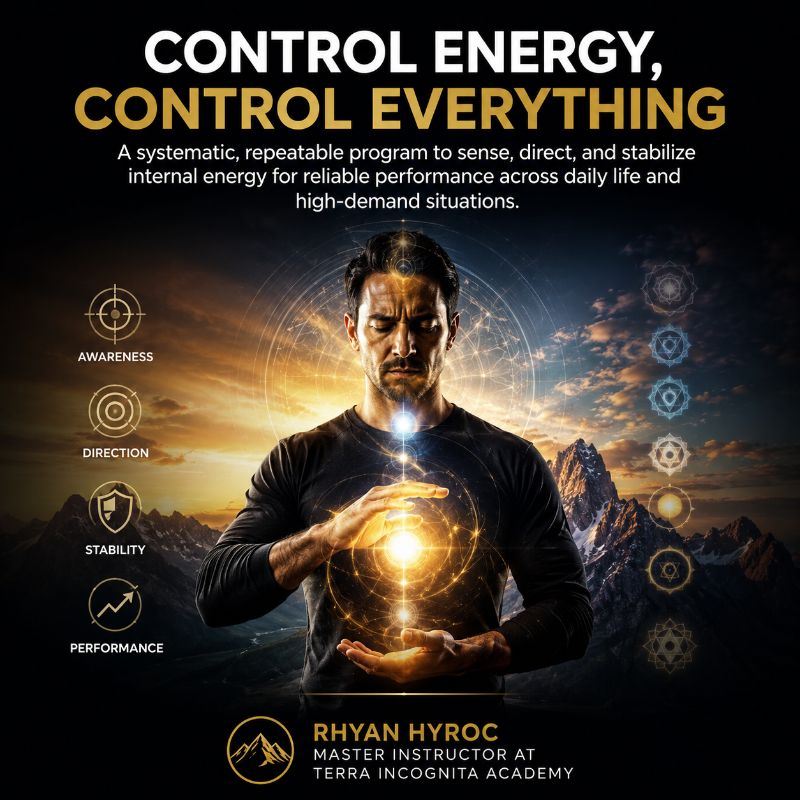
Energy Control Mastery presents a precise, practical curriculum for practitioners who already use basic breath and meditation and need reliable, repeatable control over internal energy. The course teaches measurable baseline assessment, clear fatigue markers and thresholds, and simple self-tests you can perform anytime to know your energetic state. From there you learn structured techniques to increase, decrease, stabilize, and redistribute energy using coordinated breath, attention, posture, and movement. The training codifies flow control: circulation patterns, pacing, segmentation, and timing protocols that convert momentary arousal into usable performance without overshoot or drift. Modules cover state regulation for calm focus, energized drive, rapid recovery, and sleep readiness, plus daily drills, progress-tracking systems, and maintenance cycles designed to prevent plateaus. You will also get concrete methods for managing attention and environment: setting boundaries, hygiene practices for attention, and situational modulation for meetings, presentations, athletic events, and high-stakes conversations. Each lesson includes error-correction: common failure modes, indicators of overactivation or underactivation, and step-by-step reset procedures. No ritual theatrics, no speculative metaphysics—every protocol is drawn from applied occult physiology, breath science, and somatic regulation traditions adapted for modern performance. Outcomes are practical: consistent state control, reduced energy volatility, faster recovery, and dependable performance when it matters.
Instructor: T.I. Team
Level: everybody
Duration: 8 weeks
Price: €39
Course Curriculum
Module 1 — Baselines, Signals, and Reliable Self-Measurement
- The Energetic Calculus: Signal, Stability, and Readiness in Spiritual Praxis for Self-Mastery
- 1.2 — Baseline Mapping: Signals, Thresholds, and Fatigue Markers
- 1.3 — Attention as the Steering Wheel: Stability, Drift, and the Hindrances
- 1.4 — Breath-Somatic Coupling: The Control Interface
- 1.5 — Functional Balance: Pacing and Conservation Principles
- 1.6 — State Labels: Calm Focus, Drive, Recovery, Sleep Readiness
- 1.7 — Environment and Attention Hygiene: Boundaries Without Drama
- 1.8 — Baseline Assessment Protocol (BAP): Your Weekly Calibration
Module 2 — Theory & Classical Mechanics of Control (Why the Methods Work)
- 2.1 — Patanjali’s Control Model: From Scatter to One-Pointed Function
- 2.2 — The Hatha Mechanics: Regulation Without Strain
- 2.3 — Visuddhimagga Diagnostics: Stability, Clarity, and Energy as a Triad
- 2.4 — Zhuangzi’s Principle: Effortless Control Through Right Pacing
- 2.5 — Hygiene of Function: Load, Recovery, and Sustainable Output
- 2.6 — Circulation and Segmentation: How Attention Moves Energy
- 2.7 — Timing Protocols: When to Increase, Hold, or Discharge
- 2.8 — Failure Mode Library: The Six Predictable Breakdowns
Module 3 — Energetic Preparation: Building the Engine and the Brakes
- 3.1 — The Three Levers: Breath, Attention, Posture (and Their Order of Use)
- 3.2 — Increasing Energy Safely: Drive Without Agitation
- 3.3 — Decreasing Energy Cleanly: Downshift Without Collapse
- 3.4 — Stabilization: Holding a State Under Variable Conditions
- 3.5 — Redistribution: Rebalancing Head-Heavy or Chest-Tight Patterns
- 3.6 — Reset Methods: 90 Seconds, 5 Minutes, 20 Minutes
- 3.7 — Sleep Readiness: Downshifting the System at Night
- 3.8 — Maintenance Cycles and Plateaus: When Progress Stalls
Module 4 — Integration & Mastery: Reliable Control in Life and High-Demand Situations
- 4.1 — The Daily Operating System (DOS): Morning, Midday, Evening
- 4.2 — High-Demand Performance Protocols: Calm Focus and Controlled Drive
- 4.3 — Stress Proofing: Overload Prevention and Fast Decompression
- 4.4 — Interaction and Environment Management: Situational Modulation
- 4.5 — Real-Time Troubleshooting: Correcting Drift Mid-Task
- 4.6 — Building Your Personal Control Map: If–Then Rules and Protocol Cards
- 4.7 — Long-Term Stability: Maintenance, Deloads, and Skill Retention
- 4.8 — Mastery Assessment: Demonstrating Reliable Energy Control