Intuition Development & Inner Guidance
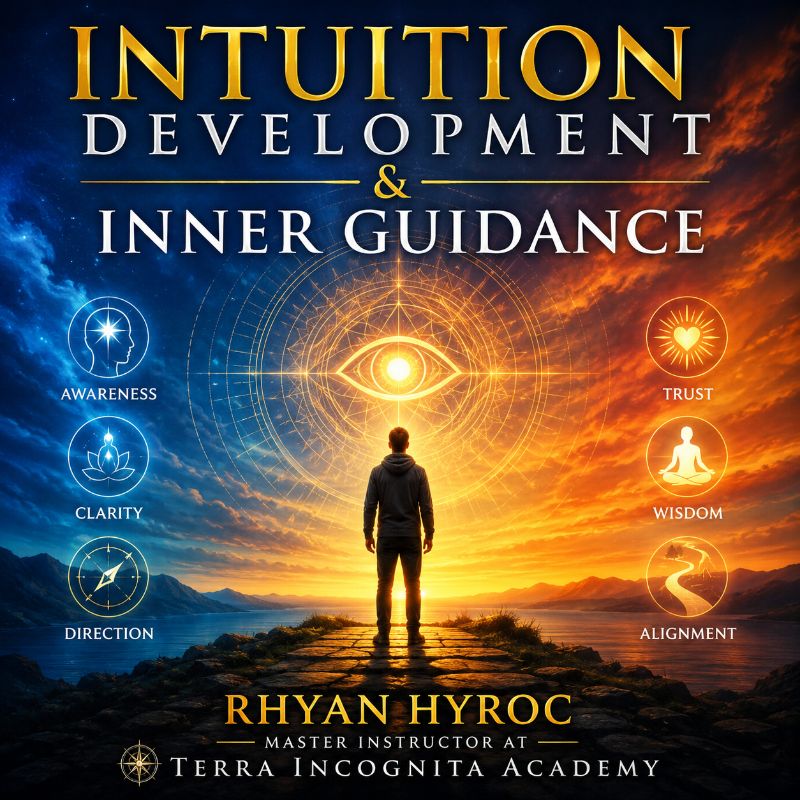
Applied Intuition is a practical, evidence-oriented program teaching repeatable skills for sensing, testing, and using inner guidance. Drawing on classical contemplative attentional methods, disciplined symbolic literacy from historical practice, and modern cognitive science, the course converts subjective impressions into verifiable data: somatic signal mapping, prediction calibration, and decision frameworks that integrate intuition with rational evaluation. Students learn meditation sequences to quiet mental noise, procedures to distinguish desire and anxiety from genuine guidance, and protocols to access inner input on demand. Instruction emphasizes verifiable practice: short prediction tests, feedback loops, calibration logs, and structured error analysis. Symbolic interpretation (dreams, spontaneous imagery, synchronicities) is treated as hypothesis-driven reading, with concrete verification methods and record-keeping. Ethical training covers impact assessment, consent, and interpersonal boundaries when acting on guidance. The curriculum is strictly non-entity-centered and avoids divination systems as primary methods; optional symbolic tools are presented only as auxiliary practices for disciplined interpretation. Students finish the course with a personal diagnostics toolkit: repeatable criteria for differentiating fear from intuition, an attention-stabilizing meditation repertoire, state-shifting protocols for accessing guidance on demand, and decision templates that balance intuitive input and analytic reasoning. The result: clearer choices, calibrated confidence, and a reproducible practice for inner guidance that performs under real-world uncertainty.
Instructor: T.I. Team
Level: everybody
Duration: 8 weeks
Price: €29
Course Curriculum
Module 1 — Foundations of Intuitive Signal Literacy
- 1.1 Operational Definitions: Intuition as Signal, Not Story
- 1.2 Attention Stabilization I: Basic Sit, Count, Return
- 1.3 Somatic Channel: Body Signals Without Superstition
- 1.4 Emotional Channel: Signal vs. Mood vs. Need
- 1.5 Cognitive Channel: Images, Phrases, and Pattern Recognition
- 1.6 The Fear–Intuition Differential: Diagnostic Criteria
- 1.7 Calibration Logging: Building Trust Through Measurement
- 1.8 On-Demand Access I: Asking Clean Questions
Module 2 — Theory, History, and the Psychology of Inner Guidance
- 2.1 William James: Pragmatic Tests for Inner Experience
- 2.2 Jung I: Symbols as Psychological Data (Not Oracles)
- 2.3 Jung II: Projection, Shadow, and Distorted Guidance
- 2.4 Kahneman: Bias Maps and the Limits of “Gut Feeling”
- 2.5 Dreams: A Verification-First Interpretation Protocol
- 2.6 Synchronicity: Meaning Without Magical Thinking
- 2.7 Stoic Metacognition: Separating Impression from Assent
- 2.8 Decision Framework I: Dual-Track Evaluation (Signal + Evidence)
Module 3 — Disciplined Inner Conditions: Energy, Attention, and State Control
- 3.1 Patanjali I: Abhyasa and Vairagya as Training Principles
- 3.2 Breath and Posture: Rapid Downshifting for Clear Perception
- 3.3 Sensory Gating and Cognitive Hygiene: Reducing Signal Contamination
- 3.4 Emotional Regulation: Holding Fear Without Obeying It
- 3.5 Focusing II: The Felt Sense as an Inner Compass
- 3.6 Timing Rules: When Not to Trust a Signal
- 3.7 Ethics I: Boundaries, Consent, and Impact Assessment
- 3.8 Decision Framework II: Premortem + Intuition Check
Module 4 — Integration and Mastery: Reliable Guidance in Real Decisions
- 4.1 The Full Stack: From Signal Capture to Responsible Action
- 4.2 Confidence II: Trust Repair After a Wrong Call
- 4.3 Advanced Verification: Competing Hypotheses and Disconfirming Tests
- 4.4 On-Demand Access II: Rapid Cycles for Real-Time Decisions
- 4.5 Social Pressure and Mixed Signals: Maintaining Discernment
- 4.6 Complex Decisions: Multi-Criteria Clarity Under Uncertainty
- 4.7 Optional Symbolic Practice: Minimalist Tarot-as-Symbol Drill (Non-Core)
- 4.8 Capstone: 30-Day Intuition Development Field Study