Invoke Without Ritual Dependency
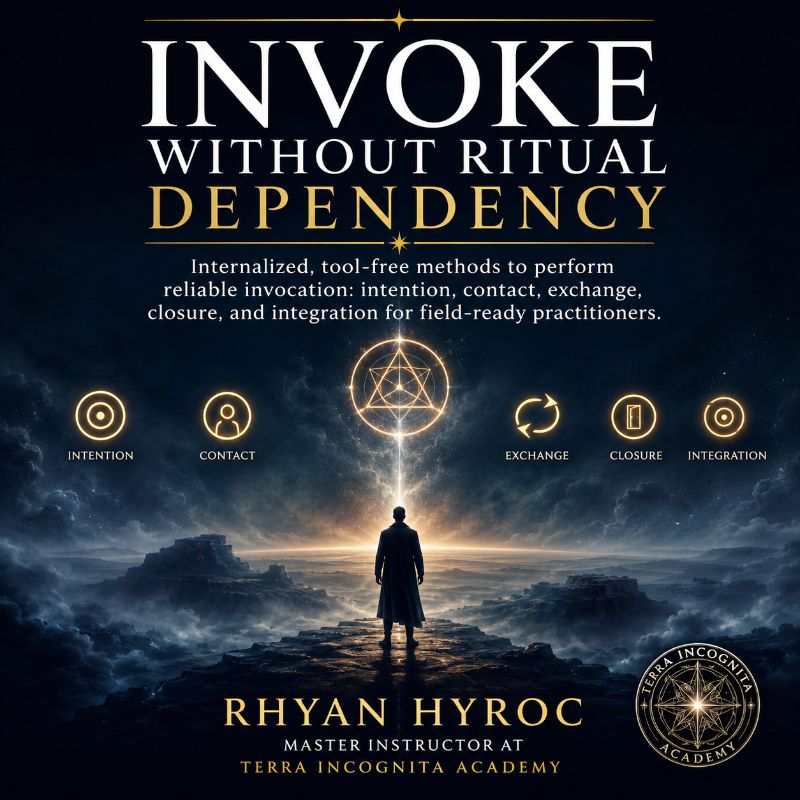
This course teaches precise, repeatable methods for invocation without dependence on external ritual apparatus. You will internalize a compact invocation sequence—intention-setting, contact, exchange, closure, and integration—so encounters are reliable, ethical, and portable. Instruction is practical and evidence-oriented: concentration drills, attentional gating, visualization compression, rapid state-entry/exit, phrase-keys, micro-gesture anchors, and validation protocols. All spirit contact in this curriculum is framed as cooperative guidance: spirits are treated as intelligent, benevolent collaborators and initiatory partners. The course gives clear boundaries and consent practices designed to preserve autonomy for both practitioner and guide. No lineage-specific ceremonial prerequisites, no cataloguing of spirits, and no coercive language are used. This is operational training for intermediate practitioners with baseline meditative control and prior ritual experience who want dependable performance in constrained environments. Students receive structured practice schedules, journaling templates, and calibration metrics to monitor signal quality and prevent drift. Emphasis is placed on communication validation—methods to distinguish signal from imagination, error-correction loops, and techniques to maintain clarity under stress or fatigue. Operational adaptability modules cover travel, public settings, low-privacy work, and resource-limited conditions; everything is designed to function without temple construction, complex tools, or intoxicants. Safety and boundaries are explicit: consent protocols, scope-limiting language, clean closure, and aftercare practices that work without formal ceremonial apparatus. The course is strictly practical: historically informed where useful, technically exact, and focused on building dependable, ethical capacities for real-world invocation.
Instructor: T.I. Team
Level: intermediate
Duration: 8 weeks
Price: €35
Course Curriculum
Module 1 — Foundations of Ritual-Free Invocation: Attention, Intention, and Portable Structure
- 1.1 — Operational Definition and Constraints: What “Ritual-Free Invocation” Means in Practice
- 1.2 — Attention as the Core Instrument: Concentration Drills and Habit Formation
- 1.3 — Attentional Gating in the Real World: Noise, Movement, and Social Proximity
- 1.4 — Intention-Setting Without Ornament: Precision, Scope, and Ethical Clarity
- 1.5 — Visualization I: Stable Imaging and Basic Multi-Sensory Construction
- 1.6 — Visualization II: Symbol Compression for Fast Deployment
- 1.7 — Baseline State Regulation: Rapid Entry/Exit and Emotional Neutrality
- 1.8 — Consistency Protocols: Metrics, Journaling, and Calibration Against Drift
Module 2 — Theory, History, and the Internal Mechanics of Contact Without External Apparatus
- 2.1 — The Five-Stage Invocation Sequence as a Control System
- 2.2 — Attention and Habit: Why Repetition Creates Reliability
- 2.3 — Communication Theory for Invocation: Channel, Noise, and Signal Integrity
- 2.4 — Verification Without Tools: Prediction, Constraint, and Post-Session Checks
- 2.5 — The Portable Boundary Model: Consent, Scope Limits, and Clean Closure
- 2.6 — Trigger Theory: Building Reliable Anchors Without Dependency
- 2.7 — Visualization as Interface: Contact Forms, Constraints, and Stability
- 2.8 — Operational Adaptability Planning: Context Mapping and Contingency Scripts
Module 3 — Energetic and Psychological Preparation for Stable, Clear Invocation
- 3.1 — The Invocation-Ready Baseline: Establishing a Stable Daily Minimum
- 3.2 — Rapid State Entry: Breath, Posture, and Micro-Gesture Stacks
- 3.3 — Emotional Neutrality Under Load: Preventing Affective Contamination of Contact
- 3.4 — Clarity and Fatigue: Maintaining Signal Quality When You’re Not at Your Best
- 3.5 — Visualization Under Pressure: Stabilizing Imagery in Noisy Environments
- 3.6 — Closure as a Skill: Clean Exit, Residual Management, and Aftercare
- 3.7 — Boundary Maintenance Without Apparatus: Scope-Limiting and Session Containment
- 3.8 — Calibration Week: Stress-Testing the Whole Stack and Adjusting Parameters
Module 4 — Spirit Relationships, Practical Invocation, and Mastery Without Ritual Dependency
- 4.1 — Relationship Protocols: Consent, Roles, and Clear Requests
- 4.2 — Contact Methods Without Tools: Establishing Presence and Stable Rapport
- 4.3 — Exchange Phase Engineering: Question Design, Constraints, and Clarity
- 4.4 — Verification in Relationship: Cooperative Testing and Error-Correction Loops
- 4.5 — Public and Travel Invocation: Low-Privacy Protocols and Silent Operation
- 4.6 — Clean Closure and Integration: Turning Contact Into Development Without Dependency
- 4.7 — Long-Term Consistency: Training Cycles, Plateaus, and Quality Control
- 4.8 — Mastery Assessment: End-to-End Performance Demonstration and Personal Protocol Codex