Merge Psychology with Ritual for Real Change
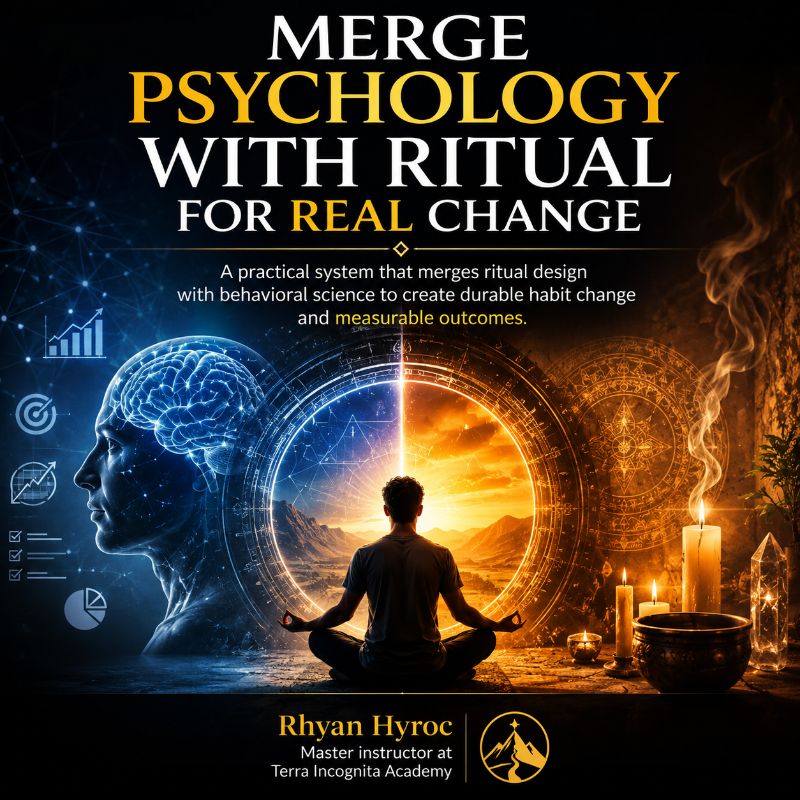
This course provides an evidence-informed, repeatable system that uses ritual structure as the interface for durable behavior change. Designed for intermediate practitioners and coaches, it maps core psychological mechanisms — cue-routine-reward, implementation intentions, reinforcement schedules, cognitive restructuring, and emotional-state modulation — onto ritual design principles that are minimal, repeatable, and measurable. Participants learn to design a Minimal Viable Ritual (MVR) as a standard operating procedure, create tracking and feedback loops, and implement shaping and relapse plans that preserve momentum. The curriculum integrates habit science (including identity-based strategies), reinforcement theory (fixed/variable schedules, shaping), single-case measurement techniques, and practical state-shifting tools (breath protocols, attention training, arousal pacing, and contextual anchors). Cognitive tools include belief alignment through reframing, micro-commitments, and implementation intention scripting. The program avoids tradition-specific ceremonial systems as core methods. Where historical ritual techniques are taught, they are presented strictly as psychological design patterns and environmental architectures for attention and meaning. If practitioners choose to include benign spirit allies or relational symbolic supports, these are handled as supplementary relational anchors — always framed as cooperative, benevolent aids that amplify attention, not as primary causal engines of change. Outcomes are practical: a replicable ritual-behavior protocol, measurable metrics and journaling templates, reinforcement and shaping plans, relapse contingencies, and a multi-domain consolidation strategy for long-term automation. The course balances theoretical rigor and step-by-step operational methods so you can implement a durable system immediately upon completion.
Instructor: T.I. Team
Level: intermediate
Duration: 8 weeks
Price: €39
Course Curriculum
Module 1 — Foundations: Ritual as a Behavior-Change System
- 1.1 Operational Definition: What Counts as Ritual Behavior Change
- 1.2 The Habit Loop as Ritual Architecture (Cue–Routine–Reward)
- 1.3 Fogg Behavior Model: Motivation, Ability, Prompt in Ritual Form
- 1.4 Implementation Intentions: The If–Then Skeleton of Ritual
- 1.5 Identity-Based Ritual: From Outcomes to Self-Concept
- 1.6 Measurement Baselines: Metrics That Actually Guide Ritual Iteration
- 1.7 Standard Operating Procedures (SOPs) for Ritual Consistency
- 1.8 Feedback Loop v1: Build–Run–Review in 7 Days
Module 2 — Theory to Practice: Reinforcement, Self-Efficacy, and Psychological Flexibility
- 2.1 Reinforcement Basics: What You Reinforce Is What You Repeat
- 2.2 Reward Schedules and Adherence: Fixed, Variable, and Hybrid Plans
- 2.3 Shaping and Graduated Rituals: Building Complexity Without Collapse
- 2.4 Self-Efficacy: The Engine of Persistence in Ritual Practice
- 2.5 Values to Action (ACT): Rituals That Hold Under Emotional Weather
- 2.6 Relapse Planning: Lapse Rules, Re-Entry Rituals, and Damage Control
- 2.7 Narrative Alignment: Reframing Without Self-Deception
- 2.8 System Audit: Diagnosing Failure Modes in Ritual Behavior Change
Module 3 — State and Environment: Emotional Regulation for Follow-Through
- 3.1 State as a Variable: Why Rituals Fail on Bad Days
- 3.2 Attention Control: Narrowing Focus to Trigger Action
- 3.3 Arousal Modulation: Downshift and Upshift Protocols
- 3.4 Stress Modulation and Recovery: Protecting the Practice Under Load
- 3.5 Environmental Design: Building a Ritual Habitat
- 3.6 Ritual Timing and Rhythm: Stability Without Rigidity
- 3.7 Emotion-Linked Cues: Working With Feelings as Prompts
- 3.8 State + System Integration: Updating SOPs and Metrics
Module 4 — Integration and Mastery: Multi-Domain Systems and Long-Term Consolidation
- 4.1 Consolidation: When to Stabilize vs When to Expand
- 4.2 Automation: Defaults, Checklists, and Reduced Decision Load
- 4.3 Renewal Cycles: Weekly, Monthly, Quarterly Ritual Reviews
- 4.4 Plateaus: Maintaining Engagement When Progress Slows
- 4.5 Habit Stacking Across Domains: Health, Work, Relationships, Study
- 4.6 Coaching Protocol: Assessment → Design → Run → Review → Iterate
- 4.7 Long-Term Relapse Resistance: Identity, Values, and Environment Alignment
- 4.8 Capstone: Build Your Personal Ritual Behavior Change Operating System