Understand the Infernal Chain of Command
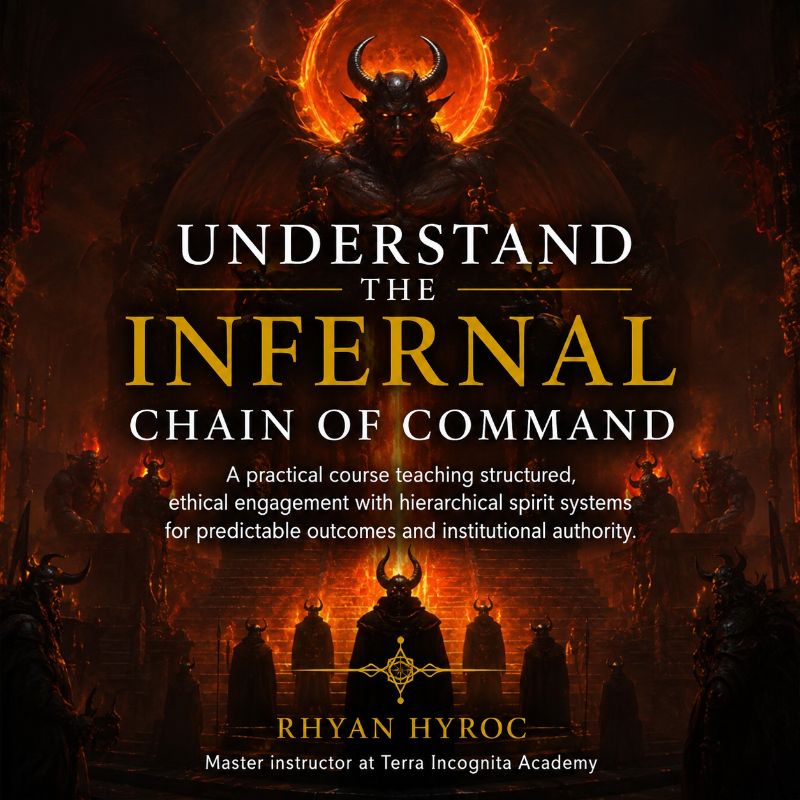
This course translates historical hierarchical praxis into a disciplined, reproducible method for working within the infernal chain of command. It equips intermediate practitioners with role-mapping, relational positioning, and protocol design so engagements produce consistent, measurable results. The curriculum treats spirit intelligences as cooperative agents whose offices, jurisdictions, and mandates must be read and respected. Students learn to diagnose misalignment when outcomes stall, to select the correct level of contact for a given objective, and to craft decision pathways that align human intent with institutional authority. Practical exercises cover authorization sequences, escalation and de-escalation protocols, petition construction, and communication briefs tailored to different offices and functions. Emphasis is on structure: identifying who authorizes what, who implements, and where veto points and gatekeepers sit inside systems. Ethics and responsibility are integrated into every module. The course teaches how intent clarity, accountability contracts, and boundary management preserve relationships and prevent misuse. The approach is historically grounded, drawing operable lessons from long-standing ritual orders and administrative traditions without relying on named grimoires or spirit catalogues. Participants leave able to design operational plans, measure results, and maintain sustained, reciprocal relationships with spirit offices that support human development and institutional goals.
Instructor: T.I. Team
Level: intermediate
Duration: 8 weeks
Price: €39
Course Curriculum
Module 1 — Structural Literacy: Mapping the Infernal Chain of Command
- Lesson 1.1 — The Infernal Chain of Command as an Operating Model (Not a Myth)
- Lesson 1.2 — Offices, Functions, and Ranks: Building Role Maps that Predict Outcomes
- Lesson 1.3 — Mandate and Jurisdiction: Permission Boundaries Inside a Hierarchy
- Lesson 1.4 — Decision Pathways: How Requests Move Through the Infernal Chain of Command
- Lesson 1.5 — Stakeholder Analysis: Allies, Gatekeepers, Implementers, Veto Points
- Lesson 1.6 — Diagnosing Misalignment I: Acting Outside the Chain of Command
- Lesson 1.7 — Influence and Compliance: Structuring Requests for High Cooperation
- Lesson 1.8 — Operator Ethics: Accountability Inside Hierarchical Power
Module 2 — Theory & Institutional Logic: How Hierarchies Think and Enforce Order
- Lesson 2.1 — Authority Types: Charismatic, Traditional, and Rational Legitimacy in Practice
- Lesson 2.2 — Institutional Cognition: How Hierarchies Decide What Is Relevant
- Lesson 2.3 — Bottlenecks and Uncertainty: Where Power Hides in the Chain of Command
- Lesson 2.4 — Paratext and Protocol: How Presentation Determines Reception
- Lesson 2.5 — Escalation and De-escalation: When to Move Up, Down, or Sideways
- Lesson 2.6 — Diagnosing Misalignment II: Symptoms, Root Causes, and Structural Remedies
- Lesson 2.7 — Drafting Briefs and Petitions: Operational Writing for Hierarchical Spirits
- Lesson 2.8 — Ethical Strategy: Power, Constraint, and Responsibility in Structured Engagement
Module 3 — Energetic Preparation: Stabilizing Authority, Signal, and Reception
- Lesson 3.1 — Intent as Mandate: Converting Desire into a Jurisdiction-Ready Objective
- Lesson 3.2 — Boundary Conditions: Authority Without Aggression, Openness Without Leakage
- Lesson 3.3 — Signal Discipline: Attention, Timing, and Consistency as Institutional Legibility
- Lesson 3.4 — Confirmation Design: Evidence Standards and Feedback Loops
- Lesson 3.5 — Relationship Capital: How Trust and Track Record Become Authority
- Lesson 3.6 — Deconfliction: Handling Competing Stakeholders and Cross-Purposes
- Lesson 3.7 — Structured Offer and Exchange: Reciprocity as Protocol, Not Bribery
- Lesson 3.8 — Pre-Operation Readiness Check: The Operator’s Chain-of-Command Audit
Module 4 — Strategic Engagement and Mastery: Operating Within the Infernal Chain of Command
- Lesson 4.1 — Contact Level Selection: Matching Goal Complexity to Hierarchical Altitude
- Lesson 4.2 — Sequenced Protocols: Multi-Stage Engagement that Respects Reporting Lines
- Lesson 4.3 — Briefing for Authorization: How to Request Sponsorship, Not Just Action
- Lesson 4.4 — Working with Gatekeepers: Access, Routing, and Respectful Constraint
- Lesson 4.5 — Managing Implementers: Delegation, Constraints, and Quality Control
- Lesson 4.6 — Corrective Routing: What to Do When the System Says “No,” “Not Here,” or “Not Now”
- Lesson 4.7 — Measuring Results and Maintaining the Relationship: Reviews, Records, and Next Mandates
- Lesson 4.8 — Capstone Integration: Your Personal Chain-of-Command Operating System