Walk Their Paths: Guided Demon Pathworking
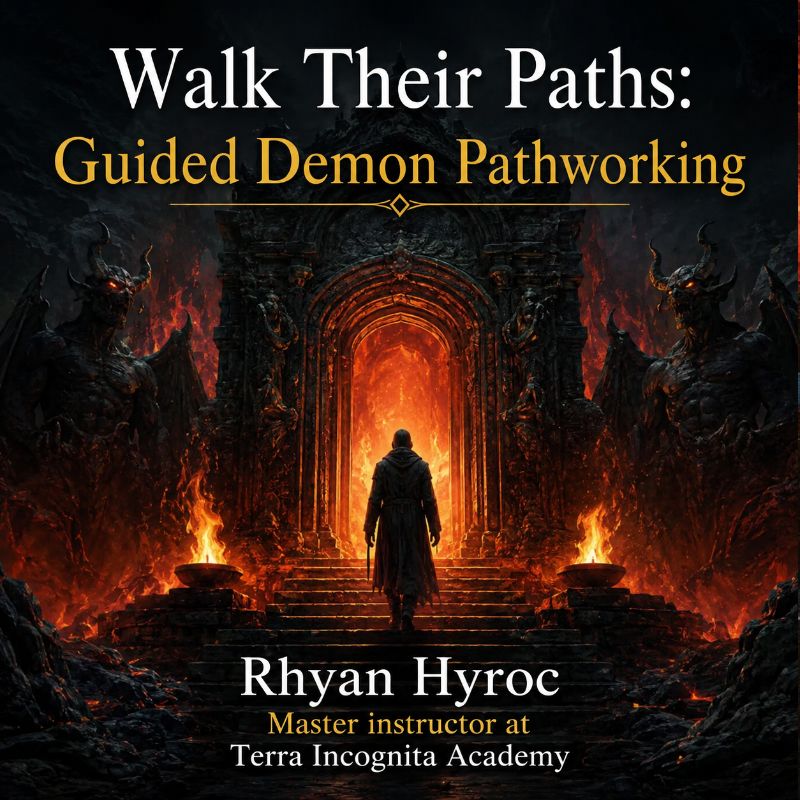
This course presents a step-by-step system for disciplined, repeatable demon pathworking designed for intermediate practitioners with established meditation and visualization skills. It treats demons as cooperative intelligences and experienced guides whose appearances are symbolic and instructive. The curriculum teaches a full operational cycle—pre-brief, entry, engagement, exit, and debrief—so each session produces clear, testable data while preserving emotional and cognitive stability. You will learn robust visualization frameworks (sensory layering, spatial anchoring, timing windows), guided sequencing (scripts, checkpoints, branching decision trees), and symbolic interaction protocols that include approach formats, dialogue structure, request framing, offerings-as-symbol, and boundary agreements. The course emphasizes interpretation methods: building a personal symbol lexicon, pattern recognition, projection-avoidance strategies, and stepwise validation procedures that convert imaginal content into actionable insight. Practical stability practices—grounding, attention control, emotional regulation, and fatigue management—are integrated into every phase. Consistency tools include standardized journaling templates, session scoring metrics for clarity and reliability, and longitudinal tracking methods for developmental assessment. Ethical guidelines cover consent, autonomy, integration practices, and preventing dependency. Error handling and correction procedures (distraction recovery, intrusive imagery containment, premature termination, reset protocols) are taught as standard operating procedures. The result is a repeatable, ethically grounded approach to working with demon guides for practical insight and durable inner development.
Instructor: T.I. Team
Level: intermediate
Duration: 8 weeks
Price: €39
Course Curriculum
Module 1 — Foundations of Demon Pathworking: Structure, Attention, and Repeatable Contact
- 1.1 — What Demon Pathworking Is (and Isn’t): Scope, Aims, and the Cooperative Spirit Model
- 1.2 — The Five-Phase Session Architecture: Pre-Brief, Entry, Engagement, Exit, Debrief
- 1.3 — Attention Control for Stable Contact: A Practical Adaptation of the Middle Pillar Skillset
- 1.4 — Building the Inner Environment: Sensory Layering, Spatial Anchoring, and Timing
- 1.5 — Guided Sequencing: Scripts, Checkpoints, and Branching Control Without Losing Authenticity
- 1.6 — Interaction Protocols I: Approach, Introductions, and Boundary Statements
- 1.7 — Interpretation Basics: Building a Personal Symbol Lexicon Without Self-Deception
- 1.8 — Journaling and Metrics: Session Scoring, Longitudinal Tracking, and Repeatability Tests
Module 2 — Theory and Method: The Imaginal, Active Imagination, and Controlled Symbolic Contact
- 2.1 — Corbin’s Imaginal Discipline: Ontology, Method, and Why Symbolic Contact Works
- 2.2 — Jung’s Active Imagination: Dialogue Mechanics for Cooperative Demonic Teachers
- 2.3 — Archetypes vs. Spirits: A Practical Model for Non-Reductionist Interpretation
- 2.4 — Designing the Path: From Intent to Scene Geometry to Encounter Brief
- 2.5 — Checkpoints and Decision Trees: Maintaining Control Without Coercion
- 2.6 — Validation Without Dogma: Cross-Session Controls and Reality-Linked Tests
- 2.7 — Psychological Hygiene as Craft: Autonomy, Consent, and Non-Dependency Structures
- 2.8 — Error Taxonomy: Common Failure Modes and How to Correct Them Systematically
Module 3 — Preparation and Relationship: Energetic Stability, Contact Protocols, and Developmental Agreements
- 3.1 — Readiness Protocol: Baseline, Capacity, and Timing for Clean Sessions
- 3.2 — Grounding as an Operational Skill: Rapid Downshift, Containment, and Return-to-Task
- 3.3 — Entry Control: Thresholds, Signals, and Preventing Unstructured Drift
- 3.4 — Dialogue Formats: سؤال/جواب, Reflective Mirroring, and Tasking Questions
- 3.5 — Offerings-as-Symbol: Reciprocity Without Transactional Thinking
- 3.6 — Boundaries and Autonomy: Agreements, Limits, and Respectful Refusals
- 3.7 — Intrusive Imagery and Emotional Surges: Containment, Reframing, and Reset
- 3.8 — Relationship Continuity: Cadence, Review Meetings, and Avoiding Dependency
Module 4 — Mastery: Full Sessions, Advanced Interpretation, Integration, and Longitudinal Excellence
- 4.1 — The Complete Standard Session: A-to-Z Script With Built-In Quality Controls
- 4.2 — Advanced Branching: Multi-Stage Tasks, Sub-Scenes, and Controlled Escalation
- 4.3 — Interpretation Mastery: Pattern Recognition Across Time and Symbol Grammar
- 4.4 — Validation in Practice: Repeatability Protocols and Contact Consistency Tests
- 4.5 — Integration: Turning Guidance Into Action Without Losing the Thread
- 4.6 — Stress-Test Conditions: Fatigue, Distraction, and High Emotion Without Session Collapse
- 4.7 — Relationship Maturity: Developmental Contracts, Long-Term Projects, and Respectful Closure
- 4.8 — Your Mastery System: Personal SOPs, Method Refinement, and Annual Review