Achaiah: The Keeper of Secrets and the Mastery of Patience
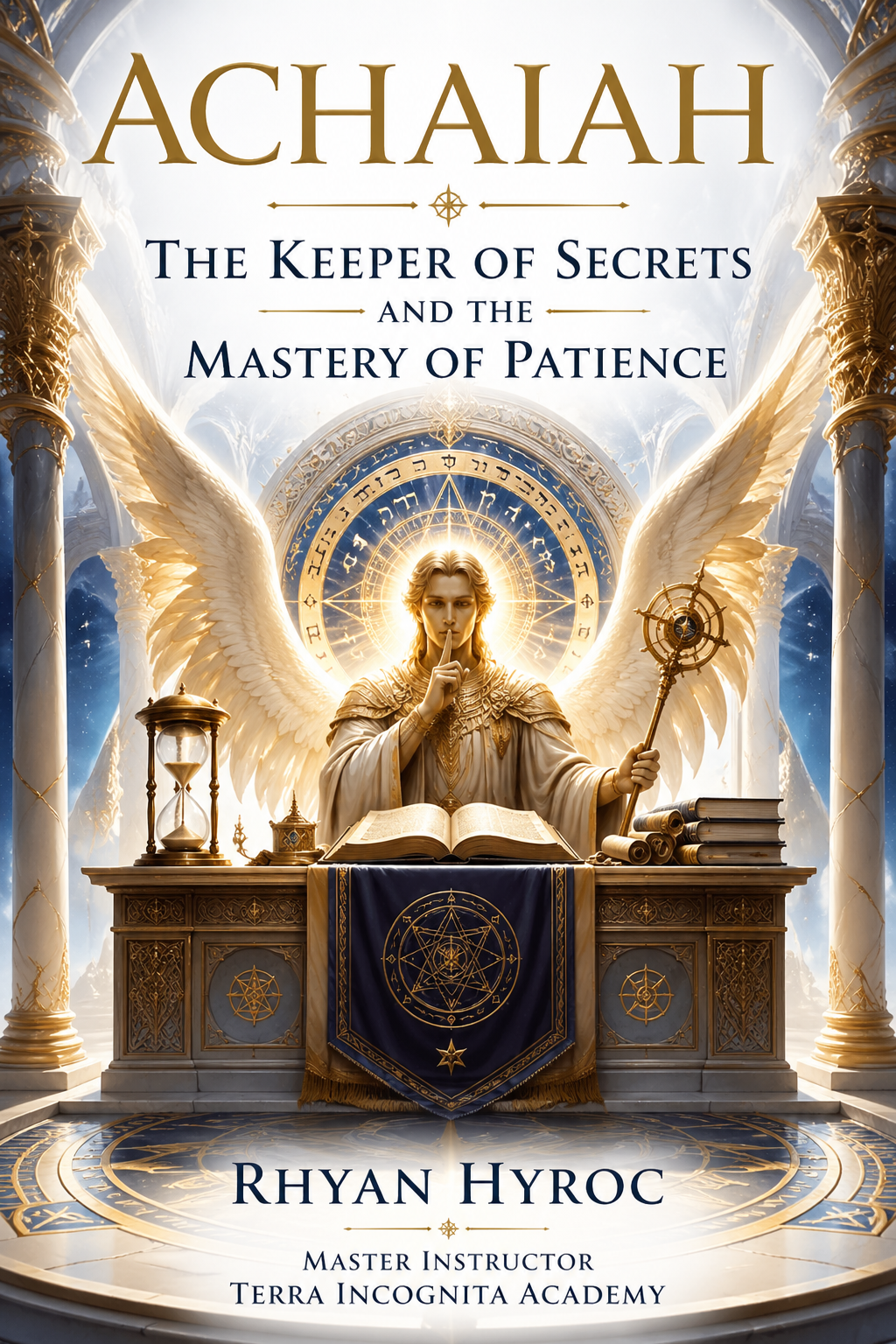
Most seekers approach angelic work with fragmented knowledge, scattered rituals, and inconsistent results. They read, they experiment, they wait—and nothing truly stabilizes. The issue is not lack of effort. It is lack of structure. This system resolves that. Achaiah: The Keeper of Secrets and the Mastery of Patience is built on a single premise: true access to higher knowledge requires preparation, alignment, and disciplined execution . Without those, what appears to be spiritual progress is often illusion. From the outset, this work positions Achaiah not as an abstract angelic figure, but as a functional intelligence within the Shem HaMephorash framework. The 72-fold Name is not treated as mythology—it is treated as a structured system, where each name represents a precise frequency and role. Achaiah’s domain is clear: patience, hidden knowledge, and controlled revelation. This distinction matters. Because most systems promise access. Very few teach readiness. Achaiah does not reveal everything immediately. The function of this intelligence is to regulate access—to ensure that what is received can be integrated without distortion. This is where the real transformation begins: not in what is given, but in what the practitioner becomes capable of holding. The material progresses with deliberate precision. You begin with foundation—not ritual performance, but internal alignment. Understanding how patience operates not as waiting, but as controlled stillness. A state where perception sharpens and noise decreases. This is essential, because without this shift, all further practice becomes unstable. From there, the system establishes context. The Shem HaMephorash is broken down into its functional components. The origin in Exodus is not presented as history alone, but as structure. Each letter, each sequence, carries weight. Achaiah’s name is analyzed through its Hebrew composition, revealing a coded system that connects directly to the Tree of Life—specifically Binah, the sphere of understanding. This is not theoretical mapping. It is operational alignment. Once this framework is in place, the work transitions into controlled interaction. Invocation, within this system, is not an emotional or symbolic act. It is procedural. Boundaries are established. Conditions are defined. The practitioner learns not only how to initiate contact, but how to regulate it. This eliminates the instability that defines most unstructured practices. At this stage, a critical shift occurs. You are no longer “seeking signs.” You are working within a system. The inclusion of psalms, sigil construction, and ritual timing is not ornamental. Each element is calibrated to reinforce consistency. The sigil acts as a visual anchor. The psalms operate as vibrational keys. The timing cycles align the practitioner with predictable energetic patterns. This creates repeatability. And repeatability creates control. The work deepens further through practical methods such as dream incubation and automatic writing. These are not presented as passive experiences, but as trained channels. With Achaiah, results do not arrive instantly. They accumulate. Patterns form. Insights stabilize over time. This is where most abandon the path. Because patience is not comfortable. But here, patience is not delay—it is the mechanism through which access becomes sustainable. As the system advances, integration becomes the focus. The knowledge gained is not meant to remain within ritual space. It must translate into perception, decision-making, and long-term development. This is where the practitioner moves from performing techniques to embodying structure. At the highest level, the work approaches what is described as the Beatific Vision. Not as a sudden revelation, but as the outcome of sustained alignment. A state where perception is no longer filtered through distortion, and truth is encountered directly. Achaiah’s role here is precise. Not to overwhelm. Not to impress. But to ensure stability at every stage. The inclusion of historical references such as Sefer Yetzirah and Liber Juratus reinforces that this is not a modern reconstruction detached from lineage. It is an applied continuation—adapted for execution without losing structural integrity. By the end, one thing becomes clear: This is not a system for curiosity. It is a system for development. If you are looking for quick results, symbolic interpretation, or loosely defined spirituality, this will not align. If you are prepared to build control, discipline, and long-term capability—this provides the framework. Because in this path, nothing is hidden without reason. And nothing is revealed without readiness.
Price: €15