Sandalphon: The Discipline of Prayer and Malkuth
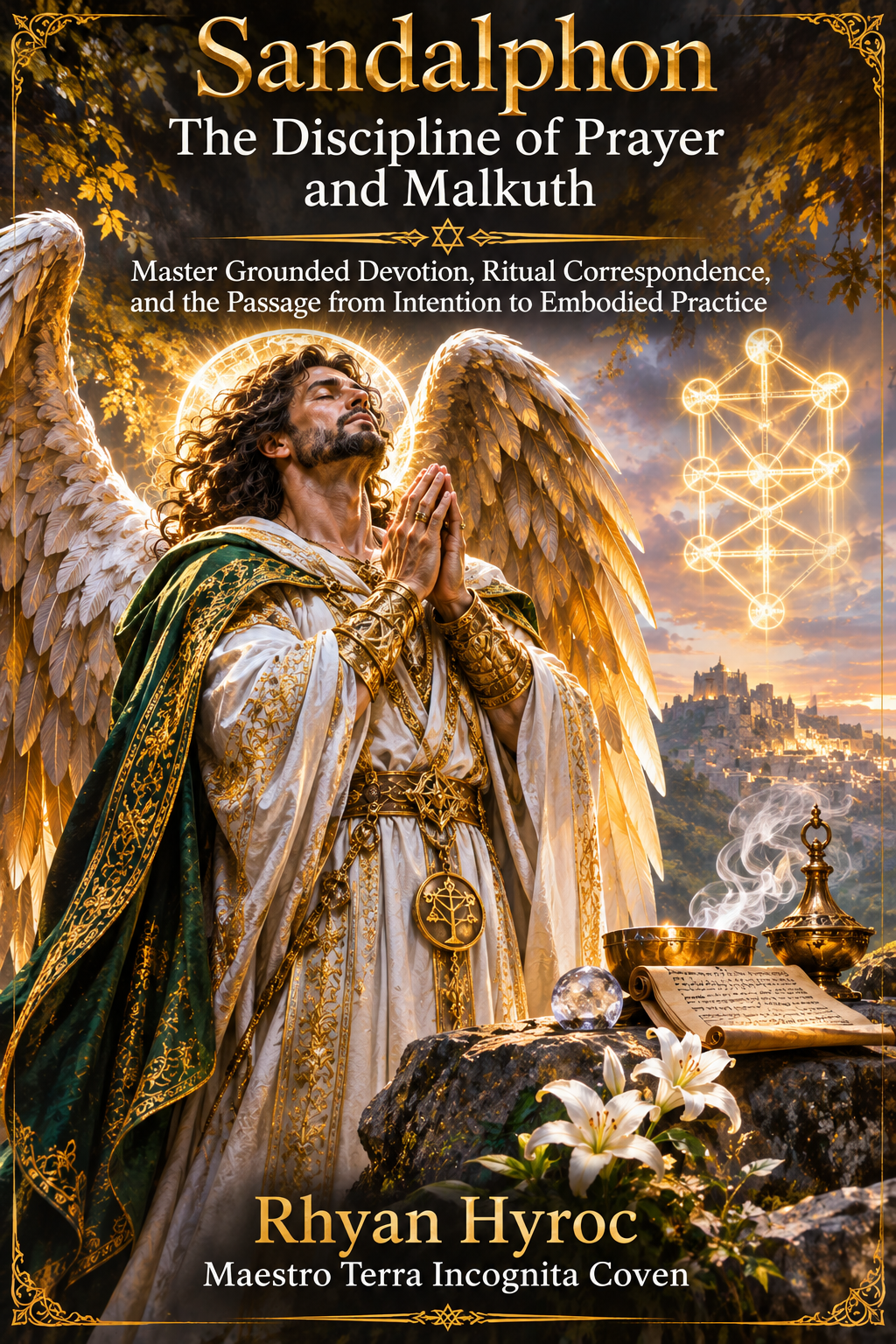
Sandalphon: The Discipline of Prayer and Malkuth Master Grounded Devotion, Ritual Correspondence, and the Passage from Intention to Embodied Practice Prayer requires more than aspiration: it requires attention, form, and a life capable of carrying its intention. For the practitioner, the difficulty is not always finding words to speak or correspondences to assemble. It is establishing a practice in which intention, speech, and deed remain answerable to one another. You may sustain a devotional moment yet struggle to give it a durable place in daily life. You may know the association between Sandalphon and Malkuth without knowing which historical sources support a particular attribution, or how that attribution should shape your work. These are questions of method, not merely enthusiasm. This book places grounded devotion at the centre of Sandalphon practice. It approaches the archangel as a benevolent, intelligent teacher and ally, and the Kingdom of Malkuth as the place where spiritual attention becomes practical responsibility. Why scattered sources leave a gap A prayer, an angelic name, a colour attribution, and a talismanic image do not necessarily belong to the same historical framework. When gathered without attention to provenance, they can appear to form a continuous tradition even where the evidence calls for distinctions. The practitioner needs more than a collection of materials: the practitioner needs a way to assess them. The Sandalphon of Jewish angelic tradition must be distinguished from the archangelic correspondences of later Hermetic Qabalah. Likewise, texts concerned with letters, angelic names, or theurgic aspiration cannot simply be treated as interchangeable witnesses to Sandalphon. Source-conscious practice preserves these distinctions while making room for clearly identified contemporary adaptation. A grimoire-style monograph with a defined foundation Written by Rhyan Hyroc and published by Terra Incognita Academy, Sandalphon: The Discipline of Prayer and Malkuth joins historical study with structured devotional work. Its purpose is disciplined relationship: prayer made precise, contemplation made stable, and Malkuth approached through practical, sustained effort. The historical foundation includes the prayer-crown imagery of the Babylonian Talmud, Hagigah 13b. Sefer Yetzirah, Sefer Raziel, and Liber Juratus Honorii provide carefully identified contexts for letter mysticism, angelic names, and theurgic aspiration. Their relevance is examined without making them say the same thing or assigning them the same evidential role. Across thirty chapters, the work proceeds from foundations and documentary study to preparation, devotional relationship, practical exercises, and advanced integration. Historical material and contemporary adaptations remain distinguished throughout. The result is a framework in which ritual choices can be considered, documented, and revised without diminishing devotion. What you will learn Establish the operative relationship between intention, speech, and deed, supported by a practitioner's rule of ethics, consistency, and interpretive restraint. Examine what the documentary record attests about Sandalphon, including name variants and the crown-making tradition, before extending those materials into practice. Compare angelic hierarchies and the Sandalphon–Metatron relationship without collapsing distinct systems into a single account. Read Sefer Yetzirah and Sefer Raziel within their identified contexts, alongside the distinct theurgic lineages considered through Honorius, Solomon, Agrippa, and Dee. Prepare body, breath, voice, and devotional space through sustained attention, accurate speech, cleanliness, material order, and a sustainable training rhythm. Evaluate the Malkuth correspondences of Adonai ha-Aretz, Sandalphon, and the Ashim, together with earth, elements, and the limits of planetary attribution. Assess colours, fragrance, Psalms, seals, and characters according to evidence, distinguishing received signs from constructed sigils. Develop a repeatable daily office of grounded prayer, cooperative invocation, and ritual appointments informed by daily rhythm, lunar observance, and planetary hours. Practise token consecration, contemplation of the Kingdom, and dream prayer with attention to devotional responsibility, receptivity, and restrained interpretation. Integrate advanced contemplative work through the necessary return to embodied life, an audit of practice, household and community service, and a documented personal grimoire. The practical work inside The practical sequence begins before formal invocation. Grounding is treated as an observable discipline involving body, breath, and sustained attention. Preparing the place of devotion includes cleanliness and arrangement. Working with voice, silence, and Hebrew letters calls for accurate speech without manufactured antiquity. Readiness is measured through a rhythm you can sustain. From that preparation, the book develops structured prayers and a complete, repeatable daily office. Invocation is framed as formal address and receptive attention within a cooperative relationship. Sandalphon is approached as teacher and ally, not as a being to compel. Ritual form supports the relationship rather than replacing it. Timing receives its own examination: daily rhythm, lunar observance, and planetary hours are considered through the discipline of appointment. Consecration work connects name inscriptions, talismans, and devotional tokens with embodied intention. The question is not only what an object represents, but what responsibility accompanies its use. Meditation and visualization lead into contemplation of Malkuth, with attention to receptivity and return. Dream prayer joins petition to a night record, while interpretation remains restrained. The later chapters place ascent, vision, and the Sandalphon–Metatron polarity within a larger requirement: contemplative work must return to a life capable of carrying it. The personal grimoire gives this continuing work a documented form. Together with the audit of practice, it supports discernment rather than unexamined accumulation. Service in household and community is treated as the completion of prayer, not a distraction from it. Who this book is for This monograph is written for intermediate and advanced practitioners of angelic devotion, Hermetic Qabalah, and ceremonial magic . It is suited to readers seeking source-conscious Sandalphon practice, disciplined prayer, and practical integration through Malkuth. It is not intended as a general survey of every archangel, a collection of interchangeable correspondences, or an approach that separates spiritual aspiration from daily responsibility. Its method asks you to study distinctions, maintain a rhythm of practice, and test interpretations rather than accept every impression as authoritative. What the work does—and does not—promise This book offers historical distinctions, structured devotional forms, and exercises for sustained practice. It does not promise visions, particular dream experiences, or guaranteed spiritual results. Nor does it present contemporary construction as received antiquity. Its aim is a disciplined relationship supported by attention, evidence, and continuing responsibility. Begin with Sandalphon as a benevolent teacher of grounded devotion. Choose Sandalphon: The Discipline of Prayer and Malkuth and undertake the passage from intention to embodied practice: a prayer you can articulate, a rhythm you can sustain, and work you can carry into daily life.
Price: €29