Sekhmet: Mastering the Mysteries of the Lioness Goddess
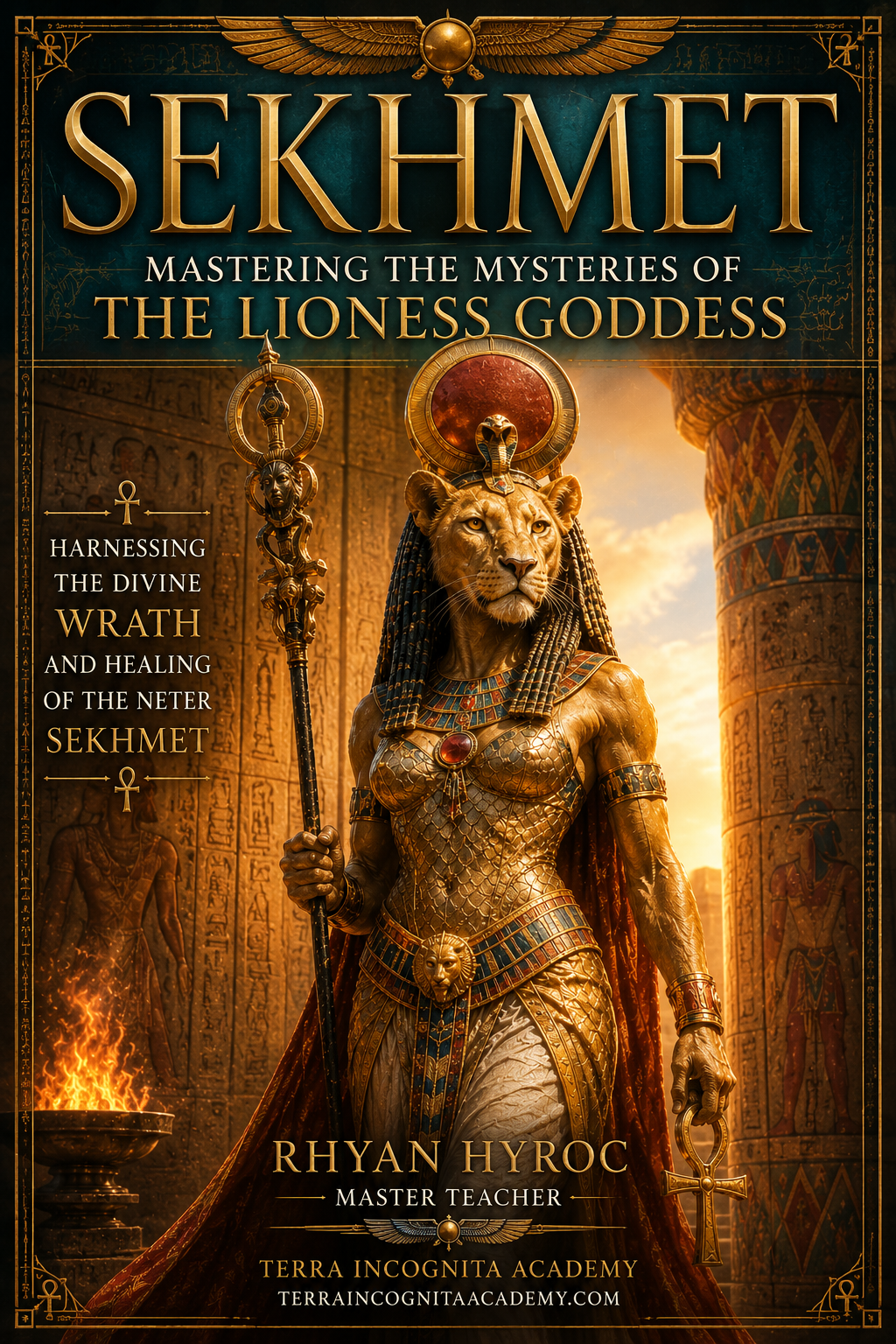
Sekhmet: Mastering the Mysteries of the Lioness Goddess There are spiritual forces that comfort. And there are forces that transform. Sekhmet belongs to the second. Feared as the lioness of divine wrath and revered as a goddess of healing, protection, and cosmic order, Sekhmet has remained one of the most compelling powers of the ancient Egyptian world for thousands of years. Yet most modern interpretations reduce her to fragments: a symbol of destruction, a mythological figure, or a simplified archetype of feminine power. This work goes far beyond that. Sekhmet: Mastering the Mysteries of the Lioness Goddess is a deep exploration into the theology, ritual systems, magical practices, symbolism, and transformative spiritual current surrounding the lioness goddess. Rather than presenting disconnected mythology, this book reconstructs Sekhmet as a living force within the Kemetic spiritual framework—fierce, intelligent, protective, and profoundly transformative. From the opening chapters, the reader enters a world where wrath and compassion are not opposites, but complementary expressions of cosmic balance. Sekhmet emerges not as chaos, but as the defender of Maat—the sacred principle of order, justice, and equilibrium that sustained ancient Egyptian civilization. The book carefully guides readers through the religious and cosmological foundations that shaped her worship. Heliopolitan, Memphite, Theban, and Hermopolitan traditions are explored in depth, revealing how Sekhmet functioned within the wider structure of Egyptian creation theology and divine hierarchy. The Pyramid Texts and Coffin Texts are examined to uncover her earliest roles as protector, purifier, healer, and enforcer of divine law. But this is not only historical study. The power of this work lies in its integration of practical spirituality and sacred application. Readers are introduced to the deeper meaning of Sekhmet’s symbols: the lioness head crowned by the solar disk, the sacred fire of the Eye of Ra, the hieroglyphic implications of her name, and the ritual role of sacred animals, solar force, blood symbolism, and celestial alignments. Every symbol becomes operational rather than decorative. One of the most compelling sections explores the legendary myth of Sekhmet as the Eye of Ra—the devastating force sent to punish humanity before being pacified through intoxication. This foundational myth becomes a lens through which the reader understands the cycles of destruction, healing, purification, and renewal operating both cosmically and psychologically. The famous Festival of Intoxication is examined not merely as an ancient ceremony, but as a transformative spiritual technology tied to emotional purification, altered states, communal healing, and sacred restoration. The book then expands into the temples and cult centers of Sekhmet, particularly Memphis, where ritual healing, sacred medicine, invocation, and priestly disciplines were practiced. These sections reveal how ancient practitioners approached Sekhmet not with passive worship, but with structured engagement designed to align human consciousness with divine power. A major strength of this work is its detailed exploration of Heka—the sacred magical force of ancient Egypt. Readers are guided into the mechanics of words of power, ritual speech, invocation methods, talismanic construction, energetic focus, sacred timing, and ceremonial alignment. Rather than vague mysticism, these teachings are presented as disciplined systems rooted in ancient spiritual logic. The celestial dimensions of Sekhmet’s mysteries are equally powerful. Her connections to Sirius, Orion, solar cycles, and the 36 decans reveal how Egyptian spirituality synchronized divine forces with cosmic movement. This allows practitioners to understand ritual timing, energetic amplification, and sacred alignment through the language of the stars. Dream incubation, visionary practice, and nocturnal communion form another extraordinary layer of the book. Readers learn how sacred space, focused intention, ritual preparation, and devotional practice may open pathways to symbolic insight and spiritual contact through dreams and altered consciousness. Advanced sections focus on healing arts, protection practices, warrior spirituality, shadow integration, ethical use of power, and long-term devotional relationships with Sekhmet. The teachings emphasize a critical principle often absent in modern occultism: true power without discipline becomes destruction. This balance between wrath and compassion defines the entire path of the lioness goddess. The book also explores Sekhmet’s evolution across late antiquity and the Greco-Egyptian Magical Papyri, demonstrating how her presence extended far beyond dynastic Egypt into broader magical traditions. Her current is shown not as obsolete mythology, but as an enduring spiritual force adaptable across eras and cultures. As the journey progresses, the teachings become increasingly personal. Sekhmet’s fire is presented not merely as external divinity, but as an inner process capable of burning away stagnation, fear, weakness, and fragmentation. Her mysteries ultimately become a path toward sovereignty, resilience, courage, and transformation. By the final pages, the reader no longer encounters Sekhmet as a distant goddess confined to temples and ruins. She emerges as a living presence—fierce in protection, precise in healing, uncompromising in truth, and transformative in power. This is not simply a study of ancient Egypt. It is an invitation to stand before the lioness and awaken the force she represents within yourself.
Price: €15