The Osiris Grimoire: Unveiling Ancient Mysteries
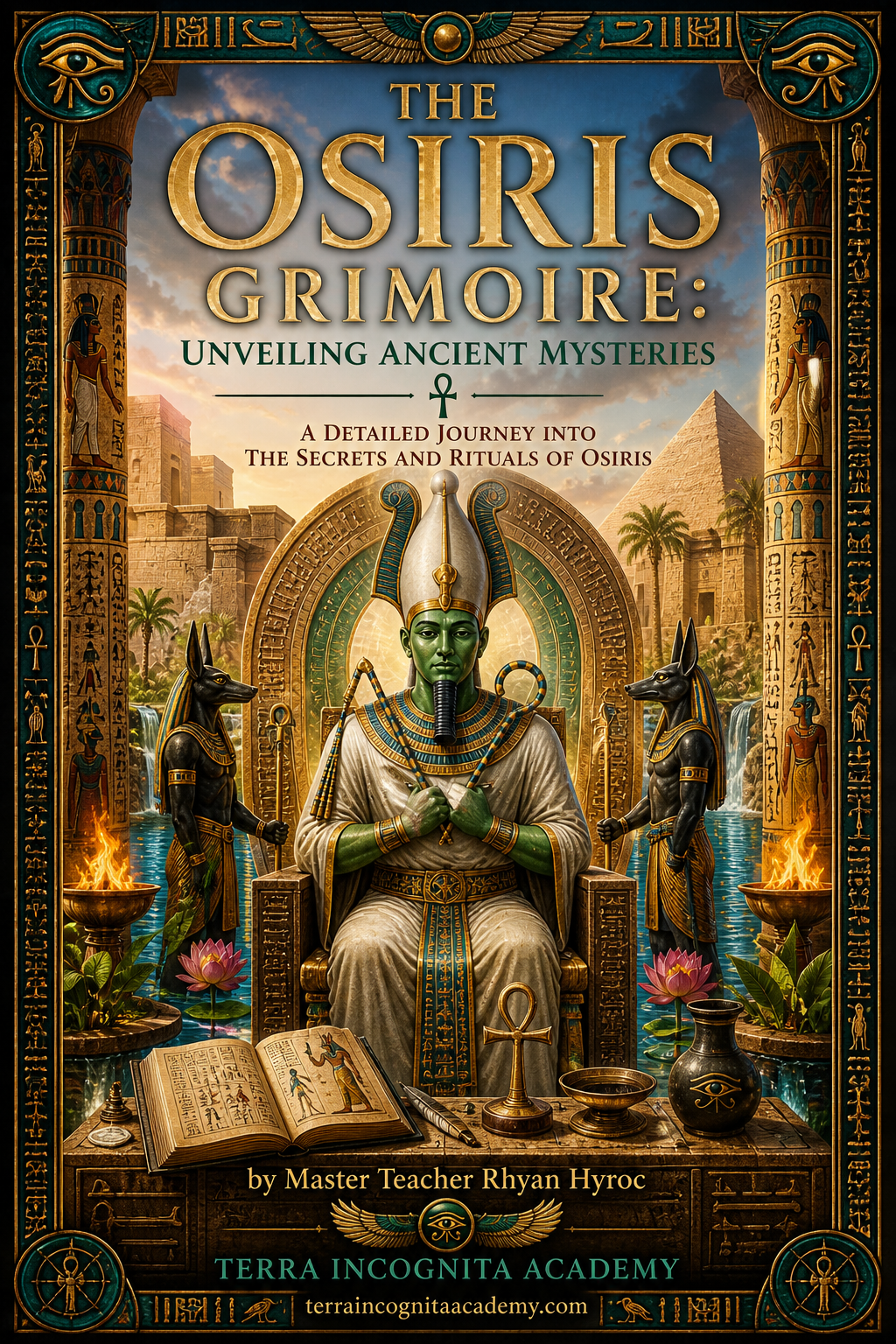
There is a reason Osiris endured. Across dynasties, empires, and entire civilizations, his presence was never reduced to a story alone. He represented something far more enduring— the principle that death is not an end, but a transition governed by order, balance, and transformation . Yet most modern material fails to capture this. What you usually find are fragmented myths, simplified retellings, or symbolic interpretations detached from their original power. They inform—but they do not transform. This grimoire does something different. It reconstructs the Osirian current as a living system. One that moves from history into practice, from mythology into direct application. From the very beginning, the work establishes a critical distinction: Osiris is not approached here as a distant deity, but as a functional archetype embedded in both cosmology and human experience . You are not just reading about death and rebirth. You are studying the structure behind it. At the core of this system lies the central myth: The dismemberment of Osiris. The restoration through Isis. The rise into sovereignty beyond death. This is not presented as narrative alone—it is analyzed as a repeatable pattern , a model that ancient practitioners engaged with through ritual, ceremony, and disciplined alignment. Every section of the grimoire builds upon this foundation. You are guided through the evolution of Osiris worship—from its earliest roots in predynastic Egypt to its expansion into the Greco-Roman world. This is not abstract history. It shows how a spiritual system adapts, survives, and extends its influence across cultures without losing its core structure. You begin to see Osiris not as static, but as a system that evolves while maintaining its internal order . Then the work shifts. From understanding… to execution. The rituals described are not decorative reconstructions. They are presented as functional processes , grounded in how ancient ceremonies operated within temples, festivals, and initiatory settings. The Abydos Mysteries. Funerary rites. Daily temple practices. Each is explored not just for what it was—but for what it did . These were not symbolic performances. They were mechanisms designed to align the practitioner with cycles of death, regeneration, and cosmic balance. And that distinction changes everything. As you move deeper, the grimoire introduces a critical layer often ignored: the internal transformation of the practitioner. Ancient Egyptian spirituality did not separate ritual from psychology or ethics. The alignment with Ma’at—truth, balance, and order—was not optional. It was required. This work restores that principle. It shows that engaging with Osiris is not about invoking power. It is about becoming compatible with it. Through structured analysis and interpretation, the grimoire bridges ancient ritual with modern application. Meditation, symbolic integration, and disciplined practice are presented as direct continuations of Osirian work—not adaptations, but extensions. The symbolic dimension is treated with equal precision. Osiris’s green skin is not aesthetic—it encodes regeneration. The mummified form is not funerary—it represents controlled transition. The Djed pillar is not decorative—it signifies stability through resurrection. Each symbol functions as a tool, not an ornament . And once understood in that way, the system becomes accessible. What makes this grimoire particularly effective is its refusal to simplify. It acknowledges the tensions within the tradition: The balance between preservation and adaptation. The integration of Osiris into other religious systems. The ethical weight of working with death-centered archetypes. It does not dilute complexity. It structures it. Toward the later sections, the scope expands. Osiris is traced beyond Egypt—into Mediterranean mystery traditions, early esoteric systems, and modern spiritual frameworks. This is where the full impact becomes clear: Osiris was never confined to a single culture. He persists because the pattern he represents is universal. Death. Fragmentation. Restoration. Renewal. The result is not just a compilation of knowledge. It is a framework. A way to understand how ancient systems operated—and how they can still operate when approached with precision and respect. This is why the grimoire resonates differently. It does not attempt to impress with abstraction. It builds clarity through structure. If you are looking for simplified mythology or symbolic inspiration, this will feel dense. If you are looking for a coherent, historically grounded, and operational understanding of Osirian mysteries , this is aligned. Because at its core, this work is not about belief. It is about comprehension. Structure. Application. And ultimately— transformation through understanding the mechanics of death and renewal.
Price: €15