Engineer Sigils That Connect to Entities
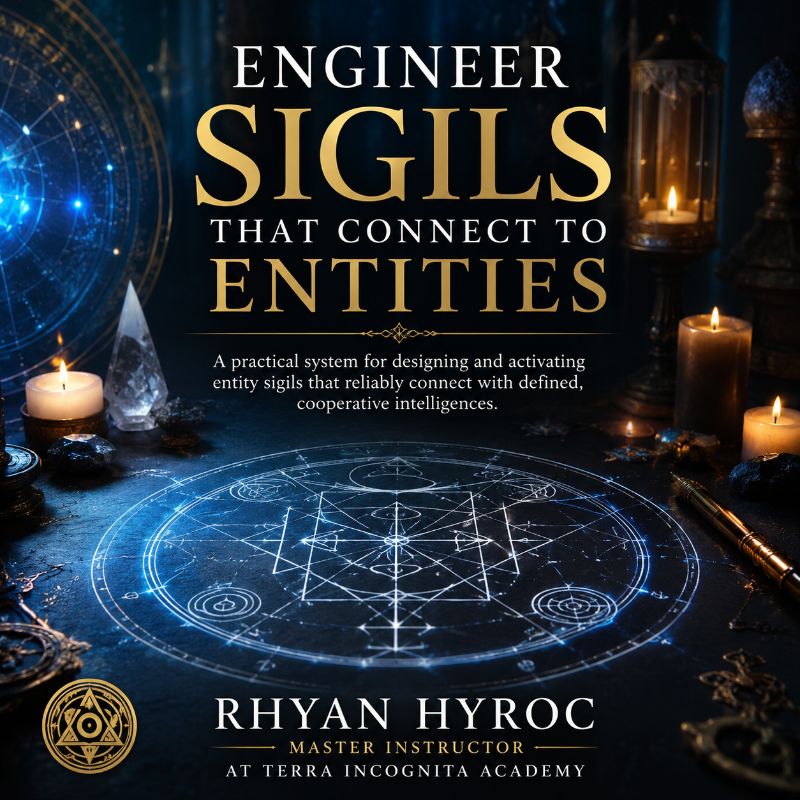
This course teaches a repeatable, engineering-first approach to creating sigils that establish functional connections with defined entities. You will learn precise target specification, rule-based symbol generation, identity-anchoring protocols, layered sigil architecture, controlled activation techniques, and verification/feedback systems. The curriculum synthesizes proven historical techniques—letter/number reduction, phonetic compression, and talismanic encoding—with modern information-theory practices such as redundancy, error-correction, and versioning. Every method is presented as a disciplined protocol you can reproduce and audit. Emphasis is on consent-based relationship building, scope management, and ethical boundaries; entities are addressed as cooperative, intelligent agents whose guidance, specialization, and limits must be respected. Practical exercises include constructing an addressable identity-anchor, encoding it via three complementary engines, building a multi-layered sigil, and executing controlled activations with measurable verification steps. Documentation standards, iterative refinement cycles, and troubleshooting diagnostics ensure workability across contexts. Out-of-scope items—full ceremonial hierarchies, catalog-driven spirit lists, and systems of enforced coercion—are explicitly excluded. This is neither pop-occult improvisation nor an introduction to basic sigil aesthetics: it is intermediate, methodical training for practitioners seeking consistent, accountable results in entity-targeted work.
Instructor: T.I. Team
Level: intermediate
Duration: 8 weeks
Price: €39
Course Curriculum
Module 1 — Specification, Addressing, and Repeatable Inputs
- 1.1 — What an Entity Sigil Is: Function, Address, and Scope
- 1.2 — Target Specification I: Entity Definition, Role, and Interface
- 1.3 — Target Specification II: Success Criteria, Evidence, and Time Windows
- 1.4 — Identity Anchors: Names, Titles, Seals, and Distinguishing Marks
- 1.5 — Correspondential Linking: Planetary, Elemental, and Functional Keys (Engineering Use)
- 1.6 — The Address Protocol: Stable Calling Without Full Evocation
- 1.7 — Documentation Standards: Lab Notebook, Sigil Sheets, and Audit Trails
- 1.8 — Ethics and Boundaries for Entity Sigils: Consent, Scope, and Reciprocity
Module 2 — Encoding Engines and Symbol-Generation Rules (Theory, History, Method)
- 2.1 — Encoding as Engineering: Determinism, Compression, and Preserve-the-Anchor Rules
- 2.2 — Letter Reduction Pipelines: Vowel/Consonant Schemes and Controlled Omission
- 2.3 — Number Reduction and Mapping: Simple Ciphers and Consistent Tables
- 2.4 — Phonetic Compression: Sound-Shape Interfaces for Address Stability
- 2.5 — Rule-Based Symbol Generation: Geometry Grammars and Stroke Constraints
- 2.6 — Monas as a Design Model: Combinatory Compression Without Mystification
- 2.7 — Redundancy and Error-Correction: Checksums, Dual Encodings, and Collision Tests
- 2.8 — Versioning and Design Review: Draft Protocols, Peer Audit, and Freeze Points
Module 3 — Activation Discipline, Attention Control, and Verification Loops
- 3.1 — Pre-Activation Conditions: Clean Attention, Baselines, and Noise Reduction
- 3.2 — Charging Methods I: Breath, Gaze, and Micro-Trance Without Impairment
- 3.3 — Charging Methods II: Rhythmic, Mantric, and Phonetic Token Charging
- 3.4 — Timing and Windows: Planetary/Practical Scheduling Without Superstition
- 3.5 — Controlled Deployment: Placement, Carrying, and Exposure Rules
- 3.6 — Confirmation Practices: Signal Types, Triangulation, and Disconfirmation
- 3.7 — Result-Tracking: Metrics, Journaling Fields, and Minimal Statistics
- 3.8 — Refinement Cycles: Iterate Without Breaking the Address
Module 4 — Relationship-Centered System Design and Mastery of Entity Sigils
- 4.1 — Relationship Praxis: Cooperative Contact, Mutual Clarity, and Role Hygiene
- 4.2 — Advanced Sigil Architecture I: Component Layout, Layering, and Precedence
- 4.3 — Advanced Sigil Architecture II: Redundancy, Error-Correction, and Fail-Safes
- 4.4 — Troubleshooting Misalignment: Wrong Target, Wrong Role, Wrong Channel
- 4.5 — Building Your Entity Sigil Library: Standards, Indexing, and Governance
- 4.6 — Standard Operating Procedures: Your Personal Repeatable Workflow
- 4.7 — Capstone Build: Engineer, Activate, Verify, and Refine an Entity Sigil (Full Cycle)
- 4.8 — Mastery Maintenance: Review Cycles, Relationship Renewal, and Long-Term Iteration