Precision Sigil Craft: Hermetic-Solomonic Methods for Outcome-Driven Results
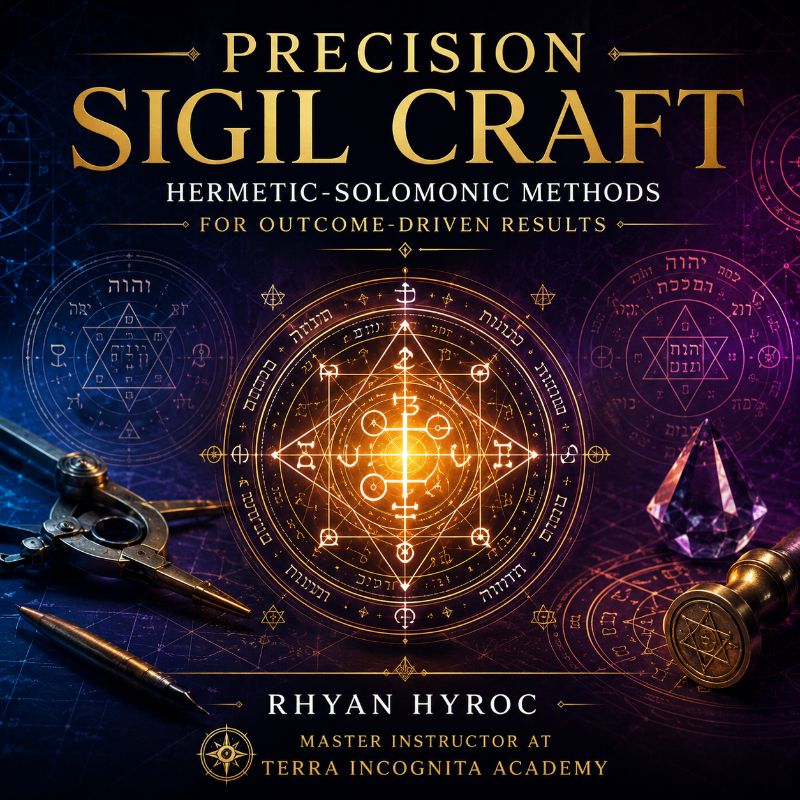
This course delivers a disciplined, grimoire-grounded methodology for creating sigils that produce measurable, repeatable results. Rooted in Hermetic-Solomonic ceremonial practice and planetary electional systems, the curriculum treats a sigil as a compact intention-schema — a command for the subtle faculties — and teaches how to translate desires into constrained, testable outcomes. Students learn letter and phoneme reduction, glyph synthesis, and numeric/planetary encoding using historical techniques (Hebrew/Latin reduction, planetary number tables, and Picatrix correspondences). Activation protocols include trance-light charging, breath-and-voice methods, and controlled release procedures that preserve operational integrity. Timing strategy follows Ars Paulina and Heptameron frameworks for planetary days/hours and electional windows to align the operation’s tempo with celestial offices. Spirit-assisted methods prioritize cooperative alignment: selecting allied spirits by office, establishing clear intent and consent, and employing Key of Solomon-style consecration logic for materials (paper, ink, wax, metal). Practical modules cover talisman manufacture, placement choices, and consecration formulas derived from Solomonic and Picatrix practice. Emphasis is on rigorous feedback loops: journaling templates, measurable success criteria, post-operation analysis, and iterative refinement. Ethical and operational hygiene is integrated throughout: defining constraints, avoiding conflicting objectives, documenting consent where relevant, and maintaining procedural cleanliness to prevent self-sabotage. The course is designed for intermediate practitioners who perform basic ritual work and now require precision, reliability, and accountable results from their sigilcraft.
Instructor: T.I. Team
Level: everybody
Duration: 6 weeks
Price: €29
Course Curriculum
Module 1 — Sigils Defined, Scoped, and Measured
- 1.1 Formal Definition: Sigils as Compact Intention-Schemata
- 1.2 Outcome Specification I: Measurable Targets and Success Conditions
- 1.3 Outcome Specification II: Constraints, Consent, and Conflict Removal
- 1.4 The Operational Model: Subtle Faculties, Correspondence, and Command
- 1.5 Baseline Protocol and Recordkeeping Standards
Module 2 — Encoding: Letters, Numbers, Planets, and Images
- 2.1 Letter/Phoneme Reduction: From Statement to Seed Pattern
- 2.2 Glyph Synthesis: Constructing a Legible, Stable Sigil
- 2.3 Numeric and Planetary Encoding: Aligning Form to Office
- 2.4 Image-Based Logic from Picatrix: When a Sigil Becomes a Talismanic Image
- 2.5 Divine Names and Letter-Power: Hermetic–Kabbalistic Structuring of Intent
Module 3 — Energetic and Ceremonial Preparation for Reliable Activation
- 3.1 Operational Hygiene: Clarity, Clean Constraints, and Stability
- 3.2 Trance-Light Charging: Controlled Attention and Minimal Alteration
- 3.3 Breath and Voice Activation: Structured Vibration and Command
- 3.4 Controlled Release: Closing, Sealing, and Non-Interference
- 3.5 Preparation Proportionality: Matching Rigor to Operational Stakes
Module 4 — Spirit-Cooperative Sigil Work and Planetary Offices
- 4.1 Spirits as Cooperative Intelligence: Office, Tasking, and Agreement
- 4.2 Ars Paulina Framework: Planetary Hours, Zodiacal Governors, and Selection Rules
- 4.3 Heptameron Structure: Day/Hour Governance and Ceremonial Containment
- 4.4 Respectful Alignment: Offerings, License to Depart, and Relationship Continuity
- 4.5 Building a Planetary Office Map for Your Practice
Module 5 — Full Operations: Timing, Materials, Consecration, and Deployment
- 5.1 Timing Strategy I: Planetary Days and Hours as Operational Scheduling
- 5.2 Timing Strategy II: Electional Windows and Layered Alignments
- 5.3 Materials and Media: Paper, Ink, Wax, Metal, and Placement Logic
- 5.4 Consecration Logic: Key of Solomon Principles Applied to Sigils
- 5.5 Spirit-Assisted Full Working: From Petition to Activation to Deployment
Module 6 — Integration, Iteration, and Mastery of Reliable Results
- 6.1 Post-Operation Review: Separating Signal from Noise
- 6.2 Error Taxonomy: Encoding, Timing, Activation, Spirit Selection, Material Deployment
- 6.3 Reliability Engineering: Iterative Refinement and Personal Benchmarks
- 6.4 Long-Arc Ethics and Hygiene: Consent, Clarity, and Coherent Objectives
- 6.5 Your Personal Operating Manual: A Complete Sigil System You Can Teach