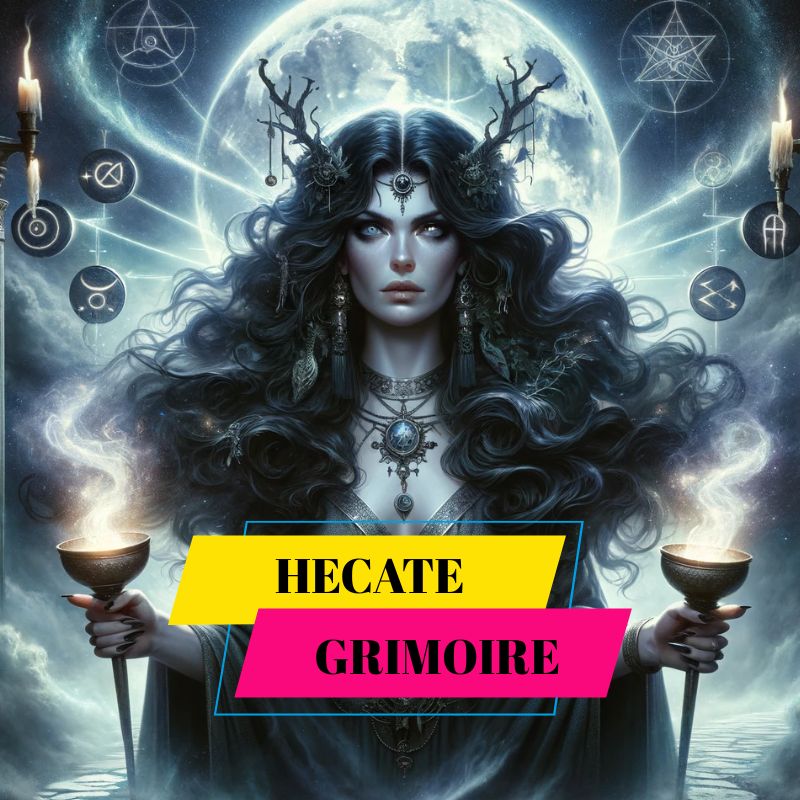
Student: Master Rhyan, Hecate is always described as a goddess of crossroads and thresholds. Why is she so central to liminal work and initiatory transitions, and what does that actually mean in practice?
Why Threshold Work Is Its Own Category
Clara, most people misunderstand thresholds because they think of them as moments. They are not.
A threshold is not the instant you decide something.
A threshold is the unstable zone between identities.
You are no longer who you were, but you are not yet who you will become. Old rules stop working. New rules have not stabilized. This is where confusion, anxiety, and bad decisions multiply.
Hecate governs this zone because it is the most dangerous and the most powerful phase of transformation.
Not the beginning.
Not the end.
The crossing.
Who Hecate Governs (Function, Not Myth)
Hecate is not a goddess of outcomes. She does not guarantee success, enlightenment, or comfort.
She governs:
Transitions between states
Identity dissolution and reformation
Moments where choice cannot be postponed
Points of no return
The space where old protections no longer apply
Hecate does not care what you choose.
She governs how you cross.
Liminal Space Is Where Most People Break Themselves
Here is the uncomfortable truth.
Most people do not fail because they lack power or intelligence. They fail because they panic inside liminal space. They rush decisions. They cling to dead identities. They seek certainty where none exists.
Thresholds expose impatience, fear, and dependency brutally.
Hecate does not remove that exposure. She structures it.
Without her, people stumble through transitions blindly. With her, the transition becomes navigable, even if still uncomfortable.
Why Crossroads Are Not About Options
People hear “crossroads” and think choice.
That is shallow.
A true crossroads appears when all available options cost you something. There is no clean path. No option preserves the old life intact.
This is where Hecate enters.
She does not tell you which path is safe. She makes it impossible to pretend there is one.
That clarity alone prevents catastrophic self-betrayal.
Hecate Governs Initiation, Not Comfort
Initiation is not learning something new. It is losing the ability to return.
Once initiated, certain illusions collapse permanently. Certain tolerances vanish. Certain behaviors become impossible without internal friction.
Hecate governs this irreversible shift.
That is why she appears in moments of:
Career collapse or reinvention
Relationship endings that change identity
Spiritual path changes
Loss of old beliefs
Forced maturation
She is present when the old life cannot be salvaged.
Why People Fear Liminal Work
Liminal work removes guarantees.
Before the threshold, you have habits.
After the threshold, you have structure again.
Inside the threshold, you have nothing solid.
Hecate does not rush you through this space. She ensures you do not lie to yourself while you are in it.
That honesty feels threatening to people who survive on certainty.
Hecate Does Not Protect You From Consequences
This matters.
Hecate is not a protective mother figure in the sentimental sense. She does not soften outcomes or cushion mistakes.
What she does is ensure that:
You understand what you are choosing
You see what you are leaving behind
You recognize when hesitation becomes self-sabotage
She governs responsibility at the moment where responsibility is most uncomfortable.
Why Liminal Work Requires Precision
Inside a threshold, small actions have disproportionate impact.
A conversation.
A decision delayed.
A boundary not enforced.
These shape the next phase far more than effort later.
Hecate sharpens awareness during this window. She makes consequences visible early instead of retroactively.
That foresight saves years.
The Role of Darkness in Hecate’s Work
Darkness here does not mean evil.
It means lack of definition.
In liminal space, identities blur. Motivations conflict. Values are renegotiated. Darkness is simply the absence of stable structure.
Hecate does not eliminate this darkness. She teaches you to move inside it without hallucinating certainty.
That skill is rare—and invaluable.
Why Hecate Appears When Old Methods Fail
People often turn to Hecate when nothing else works.
That is not coincidence.
Old methods fail because they belong to the old identity. New methods cannot function yet because the new identity has not formed.
Hecate governs the gap.
She does not give answers. She gives orientation.
Orientation matters more than answers at this stage.
Thresholds Demand Choice Without Full Information
This is the hardest part for rational minds.
At a true threshold, you never have all the data. Waiting for certainty means stagnation. Acting blindly means chaos.
Hecate sharpens intuition without turning it into fantasy. She helps you distinguish:
Fear from caution
Impulse from necessity
Attachment from responsibility
This discernment is what allows movement without recklessness.
Why Initiatory Transitions Feel Lonely
Thresholds isolate.
Old relationships stop fitting. New ones are not formed yet. Support systems weaken. Advice becomes irrelevant.
Hecate governs solitary crossings because no one else can cross for you.
This solitude is not punishment. It is functional. It prevents external voices from hijacking the transition.
Hecate and the End of Self-Deception
Liminal work collapses self-deception quickly.
You cannot pretend you are fine.
You cannot pretend the old life still works.
You cannot pretend someone else will decide for you.
Hecate’s presence accelerates this collapse.
People who rely on denial experience this as cruelty. People who value clarity experience it as relief.
Why Hecate Is Not About Speed
Many people want to “get through” transitions quickly.
That impulse usually backfires.
Crossing too fast without integration creates fragmentation. Crossing too slowly creates stagnation. Hecate governs correct pacing.
She does not let you rush or freeze comfortably.
That friction is deliberate.
Threshold Work Is About Identity Reassembly
The purpose of liminal work is not suffering.
It is reassembly.
Old identities are dismantled because they cannot support the next phase. Hecate ensures that dismantling happens cleanly, without unnecessary damage.
When done correctly, the new identity forms with fewer contradictions.
That coherence is what gives the next phase stability.
Why Hecate Is Essential for Serious Practitioners
Anyone who works deeply with transformation eventually encounters thresholds they cannot bypass.
Power does not help there.
Knowledge does not help there.
Force fails there.
Only orientation works.
That is why Hecate remains relevant across cultures and eras. Thresholds are universal. So is the need for guidance within them.
Signs You Are in a Hecate Phase
You are likely in liminal space if:
Old motivations feel hollow
Future goals feel unclear but unavoidable
You feel pressure to choose without clarity
Familiar coping strategies fail
You cannot go back, even if you try
This is not pathology. This is transition.
Hecate governs this precisely.
How to Work With Hecate Correctly
You do not ask Hecate to make decisions for you.
You ask her to:
Reveal what is actually ending
Clarify what cannot be carried forward
Show the cost of each path honestly
Stabilize perception during uncertainty
She does not comfort. She clarifies.
Why Hecate Is Often Misunderstood
People want gods to fix things.
Hecate governs the phase where things cannot be fixed—only crossed.
That makes her unpopular with those who seek reassurance and indispensable to those who seek transformation.
What Changes After the Crossing
When the threshold is crossed properly:
Confusion drops suddenly
New structure stabilizes
Decisions feel obvious instead of heavy
Energy returns
Identity coherence increases
The chaos was not permanent. It was transitional.
Hecate governs the passage, not the destination.
Where This Leaves You
Clara, Hecate governs liminal work because no other force operates comfortably where definitions dissolve.
She does not promise ease. She promises orientation.
If you are standing at a crossroads where returning is impossible and choosing feels dangerous, Hecate is not there to save you.
She is there to ensure that when you cross, you do so awake, intact, and without lying to yourself.
That is what initiation actually is.
Not elevation.
Irreversibility handled with clarity.
And that is why Hecate stands at thresholds—and always will.