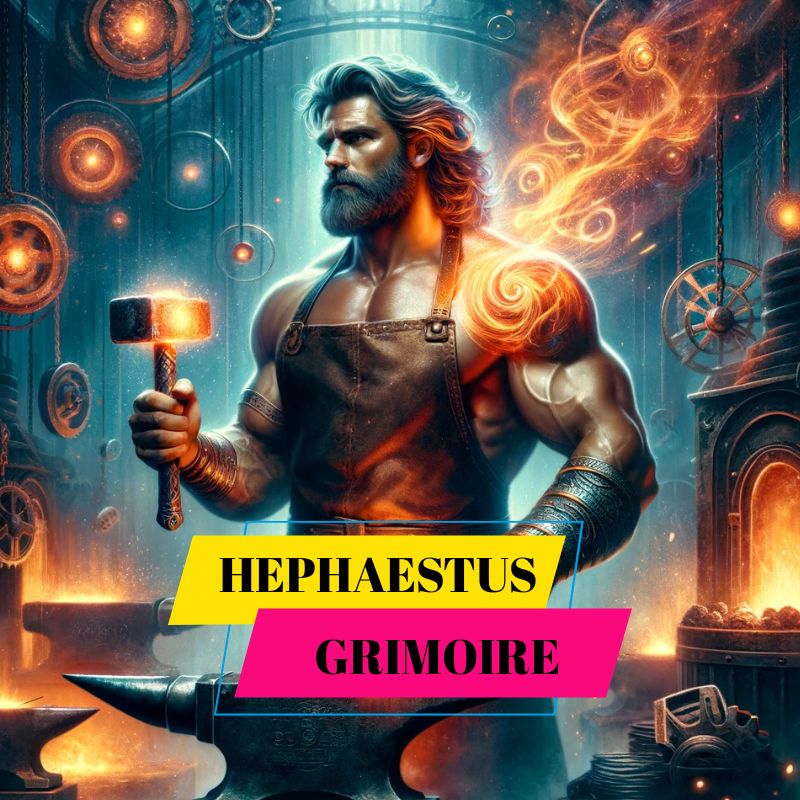
Student: Master Rhyan, people talk about inspiration, manifestation, and divine gifts—but you keep pointing to Hephaestus when the topic is skill and making. Why is Hephaestus so central to applied creation rather than vision or inspiration?
What Hephaestus Actually Governs
Adrian, Hephaestus is not about ideas. He is about work that survives contact with reality.
Hephaestus governs craft, repair, metallurgy, engineering, and functional creation. His domain begins where imagination ends. If something must work, endure, and perform under stress, Hephaestus is present.
He does not reward talent.
He does not reward inspiration.
He rewards competence under constraint.
Creation Versus Making
Most people confuse creation with making.
Creation is imagining. Making is execution.
Hephaestus is uninterested in imagination unless it can be translated into form, process, and repeatability. He operates in materials, limits, tools, and failure correction.
If something cannot be repaired, refined, or reproduced, it is not complete in Hephaestus’ world.
Why Hephaestus Is Often Ignored
Hephaestus lacks glamour.
He is not seductive.
He does not promise sudden transformation.
He does not flatter identity.
Instead, he demands time, repetition, adjustment, and humility. People who want recognition before competence tend to avoid him. People who want results eventually find him unavoidable.
Applied Skill Is the Point, Not the Byproduct
With Hephaestus, skill is not a side effect. Skill is the objective.
He does not bypass learning curves. He steepens them. Under his influence:
Weak techniques fail faster
Poor tools become obvious
Shortcuts break under load
Fundamentals reassert themselves
This is not punishment. It is refinement through exposure.
Repair Is Creation in Reverse
One of Hephaestus’ most overlooked domains is repair.
Repair requires deeper understanding than creation. To fix something, you must know how it works, where it fails, and how stress moves through it. Hephaestus trains this perception.
That is why people drawn to repair—mechanics, engineers, surgeons, coders debugging legacy systems—often resonate with him even without naming it.
Repair is where ego dies and mastery begins.
Functional Creation Rejects Fantasy
Hephaestus has no patience for symbolic work that does nothing.
A tool that looks beautiful but fails under use is not a success. A system that works only under ideal conditions is unfinished. Hephaestus tests creations under pressure.
Under his influence, questions change:
“Does it function?”
“Does it scale?”
“Does it fail safely?”
“Can it be maintained?”
If you find yourself asking these, you are already in his domain.
Why Hephaestus Pairs Poorly With Impatience
Impatience is the primary obstacle here.
Hephaestus operates through iteration. Each pass reveals flaws. Each flaw invites correction. Progress feels slow until suddenly it becomes stable.
People who abandon projects early experience Hephaestus as resistance. People who stay experience him as reliability.
Staying is the work.
Craft Is a Dialogue With Constraint
Hephaestus teaches that constraint is not the enemy of creativity. Constraint is the medium.
Materials have limits. Time has limits. Bodies have limits. Hephaestus shows how to work with those limits instead of pretending they do not exist.
This is why his creations last. They respect reality instead of arguing with it.
Making Versus Expressing
Expression seeks release. Making seeks outcome.
Hephaestus prioritizes outcome. Expression without outcome leaves nothing behind. Making leaves artifacts: tools, systems, methods, products.
If you are tired of expressing yourself and want to produce something that stands, Hephaestus is appropriate.
Why Failure Is Central to His Domain
Failure is not optional in Hephaestian work. It is diagnostic.
Failure reveals:
Weak joints
Poor assumptions
Inadequate materials
Missing skills
Under Hephaestus, failure arrives early and often—but cleanly. You learn fast or you quit. There is little room for self-deception.
This is why his path feels demanding and strangely calming at the same time.
Craft Builds Authority Quietly
Authority earned through craft is different from authority claimed through image.
When you can make something that works, arguments disappear. When you can repair what others cannot, status becomes irrelevant.
Hephaestus builds this kind of authority slowly, then permanently.
No one questions a working solution.
Why Hephaestus Is Ideal for Builders, Not Dreamers
Dreamers are welcome—but only if they are willing to become builders.
Hephaestus converts vision into method. If you resist method, he will frustrate you. If you embrace method, he will sharpen you.
This applies equally to:
Physical construction
Business systems
Technical skills
Creative production
Personal capability building
Anything that must function belongs here.
The Relationship Between Skill and Identity
Hephaestus separates identity from outcome.
You are not your first attempt.
You are not your best attempt.
You are what you can consistently produce.
This removes both vanity and despair. Skill becomes something you build, not something you are born with or denied.
That perspective alone frees many people.
Why Hephaestus Is Unforgiving of Laziness, Not Mistakes
Mistakes are expected. Laziness is not tolerated.
Hephaestus corrects mistakes through feedback. Laziness produces no feedback. There is nothing to refine.
If progress stalls, the question is never “Why am I blocked?” It is “What am I not practicing?”
Practice is the ritual here.
Functional Creation Requires Repetition
One success proves possibility. Repetition proves mastery.
Hephaestus emphasizes repeatability. Can you do it again? Can you do it under different conditions? Can someone else do it using your method?
If not, the work is incomplete.
This mindset separates hobby from craft.
Why Hephaestus Is Unsatisfying at First
Early stages feel mechanical and unromantic.
There is setup. Tool selection. Skill acquisition. Error correction. No applause. No revelation.
Then, gradually, effort decreases while output improves. Work becomes smoother. Problems resolve faster. Creation becomes reliable.
That transition is where people realize why Hephaestus matters.
When Hephaestus Is the Right Choice
Hephaestus is appropriate when:
You want something that works, not something that inspires
You are tired of starting and not finishing
You want to repair what is broken instead of replacing it
You value durability over novelty
He is not appropriate when:
You want instant transformation
You resist repetition
You avoid feedback
You want identity reinforcement instead of skill
The Quiet Satisfaction of Making
Hephaestian satisfaction is understated.
It comes from:
Things working
Problems staying solved
Tools doing their job
Systems holding under stress
No ceremony. No spectacle.
Just function.
Where This Leaves You
Adrian, Hephaestus represents a simple truth most people avoid:
What you can actually make matters more than what you can imagine.
Skill is built. Repair is noble. Craft creates authority without noise. Functional creation outlasts inspiration every time.
If you want something that works when no one is watching, Hephaestus is the god you learn from.
And once you understand his domain, you stop chasing motivation and start building capability—quietly, repeatedly, and effectively.