Attunement of Watatsumi
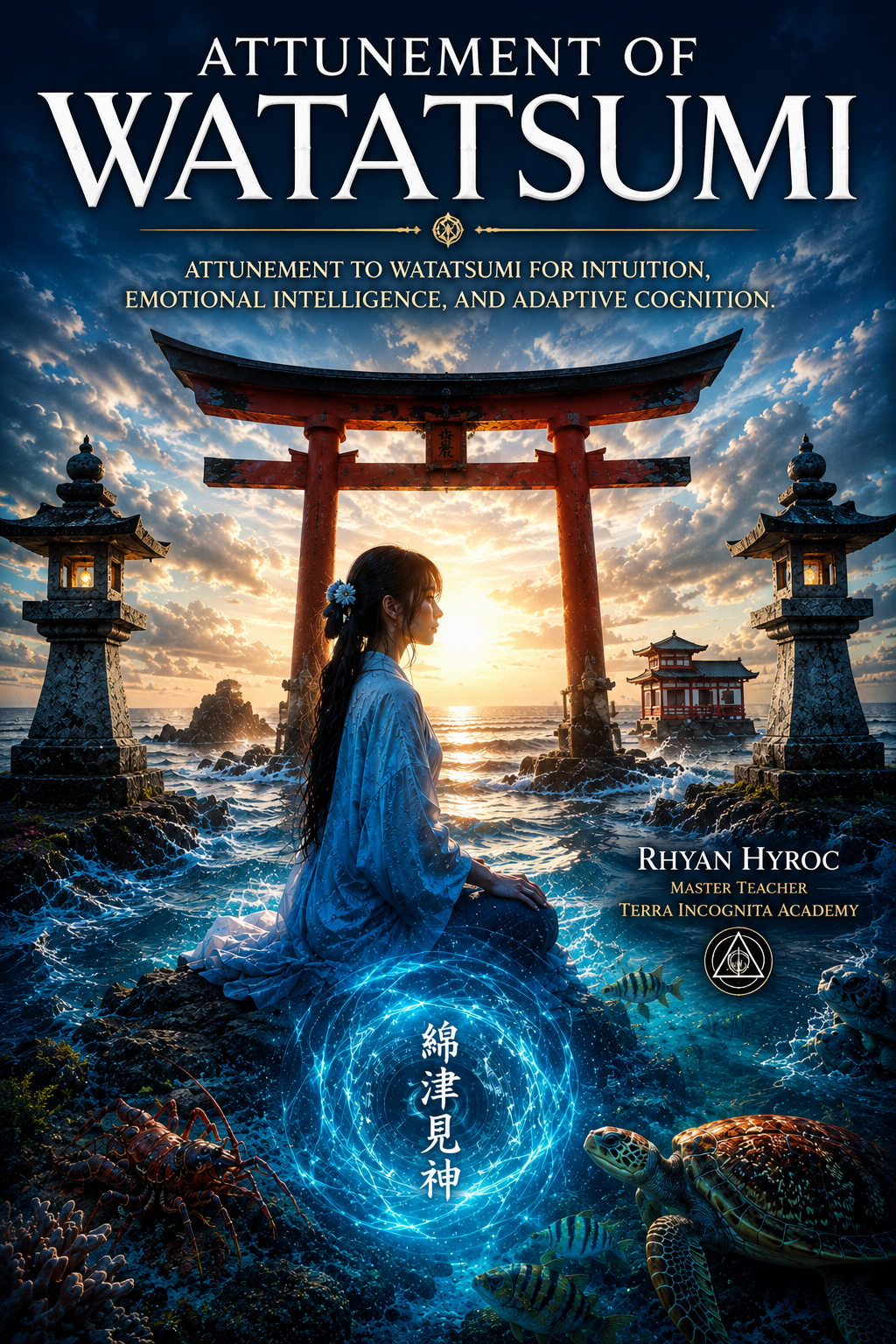
The ocean has always spoken. Not through words, but through rhythm. Through tides that never stop moving, currents that shape continents, and depths that conceal mysteries older than history itself. Attunement of Watatsumi invites you to enter that living current through a carefully structured path inspired by Watatsumi, the revered sea deity of Japanese tradition. Rather than presenting scattered folklore or romanticized mythology, this work combines historical sources, Shinto practice, energetic development, and practical spiritual disciplines into a complete framework for ocean-centered attunement. Built upon evidence drawn from the Kojiki and Nihon Shoki , this guide explores the original traditions surrounding Watatsumi, examining names, genealogies, maritime symbolism, and the role of the sea within classical Japanese spirituality. By returning to these foundational sources, practitioners gain a deeper understanding of the spiritual principles that support authentic attunement instead of relying on modern speculation. The journey continues through the sacred practice of norito , the traditional liturgical prayers of Shinto. Readers learn how purification, gratitude, acknowledgment, and respectful invocation create meaningful relationships with the kami. Every element of the ritual is presented as part of a coherent spiritual process, allowing practitioners to develop communication that reflects the cadence and harmony of ancient coastal traditions. Beyond ritual, the book introduces an entirely different way of understanding energy. The movements of tides, ocean depths, thermal layers, and natural cycles become practical models for emotional regulation, adaptive awareness, and intuitive perception. Instead of treating the sea as symbolism alone, the ocean becomes a living energetic template that teaches resilience, flexibility, and balance in everyday life. The exploration deepens further by integrating depth psychology with traditional spiritual practice. Jungian concepts, archetypal symbolism, dreams, and subconscious imagery are connected with oceanic energetics, helping practitioners interpret inner experiences with greater clarity while strengthening their relationship with benevolent sea-kami. Respect for tradition remains central throughout the work. Drawing from ethnographic observations of Japanese coastal communities, the book emphasizes cultural authenticity, proper etiquette, and sincere engagement rather than imitation or appropriation. Readers discover how offerings, ritual behavior, and devotional practice can be adapted respectfully while preserving the spirit of traditional Shinto values. A significant portion of the guide focuses on developing healthy relationships with sea spirits. Rather than encouraging dependency or passive belief, the book presents a structured framework built upon reciprocity, sincerity, consistency, and clearly defined boundaries. These principles create stable spiritual relationships capable of supporting long-term personal development. Proper etiquette receives equally detailed attention. Readers learn how to approach kami respectfully, whether practicing privately or visiting traditional shrines, understanding the importance of historical context, ritual manners, and the distinction between public religious practice and personal devotional work. One of the defining strengths of this book is its emphasis on practical embodiment. Water-resonance breathwork teaches precise breathing methods that mirror tidal rhythms, creating greater emotional stability, mental clarity, and energetic coherence. These breathing practices are complemented by carefully designed movement exercises focusing on posture, hara alignment, spinal wave mechanics, and fluid body awareness inspired by the natural movement of water itself. Grounding practices further strengthen this foundation through methods that synchronize breath, posture, and focused awareness. Saltwater resonance techniques help practitioners cultivate inner stability, allowing intuition to emerge from calm observation rather than emotional turbulence. Advanced respiratory protocols explore CO₂ tolerance, breath regulation, and the mammalian diving reflex as tools for enhancing concentration, interoception, and meditative awareness. These physiological methods complement the spiritual practices, creating a balanced system where body, mind, and energy function together. As your practice matures, the book introduces methods for understanding emotional polarity and internal energetic tides. Readers learn to recognize subtle emotional shifts, respond with greater precision, and develop emotional intelligence as an active spiritual discipline rather than a passive psychological concept. The final chapters expand these foundations into advanced intuitive applications. Water-basin scrying, somatic perception, symbolic observation, and ocean-inspired contemplative exercises become practical tools for reflection, decision-making, and personal guidance. Intuition evolves from vague feeling into a disciplined skill cultivated through repetition, observation, and spiritual alignment. Throughout every chapter, one principle remains constant: The sea is not something to control. It is something to learn from. By combining authentic Shinto tradition, historical scholarship, ritual practice, energetic cultivation, psychology, breathwork, movement, and intuitive development, Attunement of Watatsumi offers far more than an introduction to a Japanese sea deity. It presents a complete path for cultivating emotional intelligence, adaptive cognition, spiritual discipline, and a respectful relationship with one of the oldest sacred forces within Japanese tradition. Whether your goal is to deepen your Shinto practice, refine your intuition, develop greater emotional resilience, or explore the wisdom of the kami through structured spiritual work, this guide provides the knowledge, practical exercises, and historical foundation needed to walk that path with confidence and respect.
Price: €15