Geb: Guardian of Earthly Wisdom
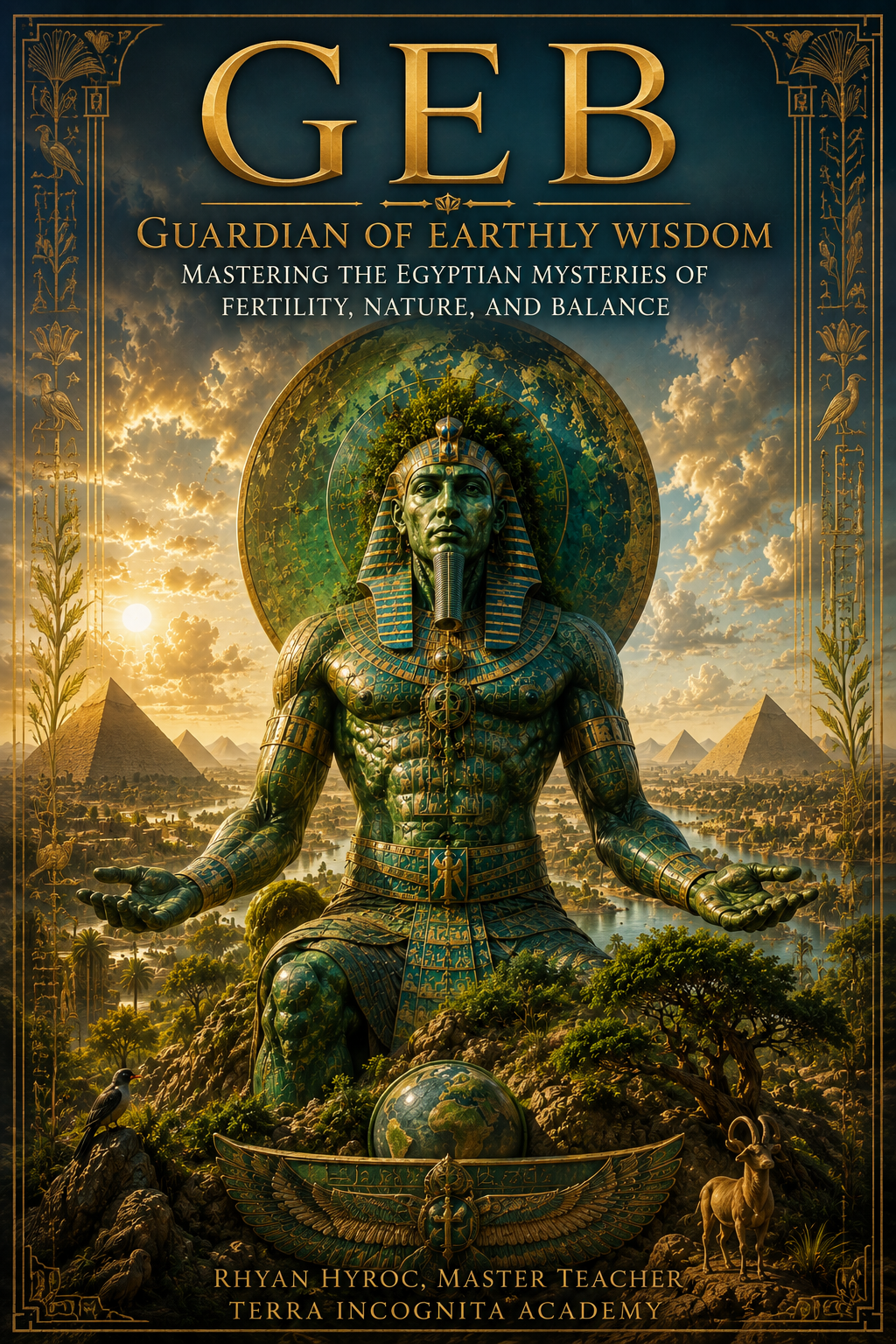
There are spiritual systems that remain intellectual. And there are traditions that become experiential. Geb: Guardian of Earthly Wisdom belongs to the second path. This is not a superficial overview of Egyptian mythology. It is a structured immersion into one of the most foundational yet misunderstood forces within the Kemetic current: Geb, the divine embodiment of earth, fertility, transformation, stability, and sacred balance. Within these pages, Geb emerges not as a distant symbolic figure, but as a living spiritual principle woven through the cycles of growth, renewal, upheaval, and regeneration that govern both nature and human existence. The work begins by opening the gates of ancient Egyptian cosmology, placing the reader directly within the sacred relationship between Geb, Nut, and Shu—the cosmic triad forming the framework of existence itself. Through this foundation, the reader develops a deep understanding of how the Egyptians perceived the earth not merely as terrain, but as a conscious and spiritually charged force. As the teachings unfold, the book progressively transitions from mythology into direct spiritual application. You are guided through Geb’s sacred symbolism, hieroglyphic representations, mythological roles, and cosmological significance, allowing the mysteries surrounding this ancient deity to become clear, structured, and accessible. The symbolic language of fertility, earthquakes, agricultural abundance, sacred cycles, and transformation is decoded in a way that connects ancient Egyptian wisdom to modern spiritual practice. One of the strongest aspects of this work is its integration of historical depth with practical ritual implementation. Rather than remaining trapped in abstract theory, the material explores how devotional practice centered on Geb can be incorporated into daily life through carefully structured systems of spiritual engagement. The reader is introduced to shrine construction, sacred offerings, devotional observances, ritual timing, recitation of hekau, dream incubation methods, and talismanic work rooted within authentic Kemetic frameworks. The practical teachings are approached with precision and reverence. Special attention is given to the ethics of heka—the sacred magical force of Egyptian spirituality. Instead of presenting spiritual power as unrestricted force, the text emphasizes responsibility, alignment, and harmony with the natural order. This transforms the work from a collection of rituals into a complete spiritual discipline grounded in balance and respect. The book also explores Geb’s role as guardian of fertility and earthly abundance in a far deeper way than commonly presented in modern occult literature. Fertility is not limited to agriculture or physical prosperity; it is explored as a multidimensional principle connected to creativity, emotional renewal, personal development, stability, and spiritual growth. The themes of transformation become especially powerful in the sections dedicated to earthquakes and upheaval. These moments are portrayed not merely as natural phenomena, but as sacred metaphors reflecting the destabilization required for renewal. Through these teachings, the reader learns how destruction and growth operate together within both spiritual development and the rhythms of the natural world. Throughout the text, the atmosphere remains immersive, contemplative, and operational. Descriptions of sacred sites, ancient cult centers, temple traditions, ritual offerings, and devotional environments create the sensation of entering an active spiritual current rather than studying a distant civilization. The teachings bridge ancient practice and contemporary application without diluting the integrity of the Kemetic tradition. Advanced sections deepen the experience further through theurgic ritual structures, energetic alignment practices, sacred timing, amulet construction, and methods for integrating Geb’s current into long-term spiritual practice. The later chapters expand beyond the individual practitioner and into the broader relationship between humanity and the earth itself. Spiritual ecology, stewardship, balance with nature, and collective responsibility become central themes, presenting Geb not only as a deity of the ancient world, but as a force profoundly relevant to modern spiritual seekers navigating disconnection, imbalance, and fragmentation. This creates a reading experience that is simultaneously mystical, practical, philosophical, and transformational. Whether your interest lies in ancient Egyptian spirituality, Kemetic devotion, ritual practice, sacred earth traditions, heka, mythological studies, spiritual ecology, or personal transformation through structured mystical systems, this work offers a deeply layered and immersive exploration designed to remain valuable long after the first reading. By the final pages, the reader does not simply understand Geb intellectually. They understand the deeper principle at the heart of the tradition: That true wisdom grows like the earth itself—slowly, cyclically, and through alignment with forces far greater than the self. Enter the mysteries of Geb. Study the sacred rhythms of earth, fertility, transformation, and balance. Walk the path of earthly wisdom through the living current of ancient Egyptian spirituality.
Price: €15