Invoke Without Ritual Dependency
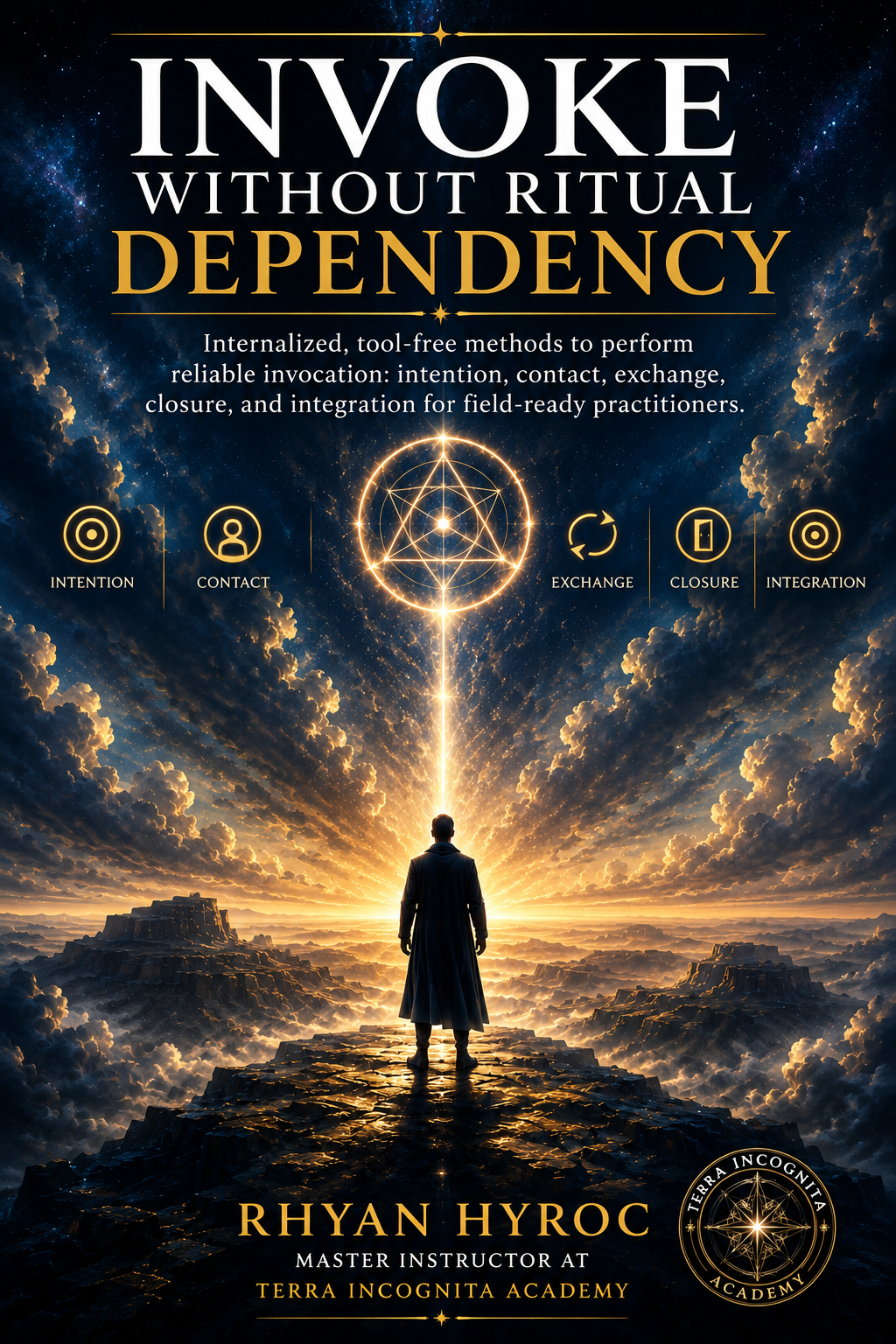
What happens when the candles are gone? What happens when there is no altar, no ritual chamber, no sacred tools, no carefully prepared environment? Can spirit communication still occur with clarity, consistency, and control? Invoke Without Ritual Dependency was created to answer that question. Most practitioners spend years building dependence on external conditions. They learn specific rituals, collect tools, construct sacred spaces, and create increasingly complex systems designed to facilitate contact. Yet many discover a troubling reality: Remove the environment, and the practice weakens. Remove the tools, and confidence disappears. Remove the ritual structure, and contact becomes uncertain. This book takes a radically different approach. Instead of teaching dependence on external mechanisms, it teaches the development of the one instrument that is always available: Your own mind. The central premise is simple but transformative. Reliable invocation does not originate from candles, circles, robes, sigils, incense, or ceremonial performance. It originates from disciplined attention. When attention becomes stable, intention becomes precise. When intention becomes precise, contact becomes reliable. When contact becomes reliable, spirit communication becomes a repeatable skill rather than an unpredictable event. This book presents a complete operational framework built around five essential stages: Intention. Contact. Exchange. Closure. Integration. These five stages form the foundation of a portable invocation system that can function virtually anywhere. Rather than relying on physical tools, the practitioner learns to carry the entire structure internally through breath, posture, focus, awareness, and disciplined mental execution. The result is a practice that remains functional whether you are at home, traveling, working, or operating in environments where traditional ritual is impossible. One of the greatest strengths of this work is its emphasis on performance rather than belief. The focus is not on collecting theories. The focus is not on creating impressive ceremonial experiences. The focus is on developing measurable skill. Throughout the book, readers learn practical methods for strengthening concentration, eliminating distraction, stabilizing awareness, and maintaining focus under pressure. Attention is treated not as a vague spiritual concept but as a trainable faculty that can be systematically improved. The book introduces concentration drills, attentional gating techniques, and awareness exercises designed to increase mental precision and reduce interference during contact. As these skills develop, practitioners learn how to establish internal triggers that replace external ritual cues. Instead of requiring physical objects to enter an invocation-ready state, the practitioner develops reliable mental anchors that can activate the process quickly and consistently. This creates a profound shift. Invocation becomes portable. Practice becomes adaptable. Results become repeatable. The work also explores communication theory within spirit contact, examining concepts such as signal integrity, noise reduction, channel clarity, and verification. Readers learn methods for distinguishing genuine communication from internal distortion while maintaining healthy skepticism and operational discipline. Particular attention is given to validation. Many systems discuss contact. Few explain how to evaluate it. This book provides practical approaches for assessing clarity, identifying contamination, improving consistency, and refining communication quality over time. Equally important is the emphasis on boundaries. Without physical circles or ceremonial protections, many practitioners feel vulnerable or uncertain. This system replaces dependence on external structures with internal boundary models built on consent, scope limitation, intentional closure, and disciplined attention management. The result is a framework that prioritizes both effectiveness and responsibility. As the reader progresses, the material advances into increasingly sophisticated territory. Rapid state-entry methods allow practitioners to enter an invocation-capable mindset in minutes rather than hours. Emotional neutrality techniques help prevent personal bias from influencing communication. Fatigue-management protocols address one of the most common obstacles to consistent practice. Visualization training develops stable internal imagery even in distracting environments. The later sections transform invocation from an occasional activity into an integrated life skill. Readers learn how to maintain clarity during travel, work, social situations, and periods of stress. The practice becomes less dependent on perfect circumstances and more dependent on cultivated capability. Perhaps most importantly, the book redefines mastery itself. Mastery is not measured by the size of an altar. Mastery is not measured by the complexity of ritual. Mastery is measured by consistency. Can you establish contact deliberately? Can you maintain clarity? Can you exchange information effectively? Can you close properly? Can you integrate the results into daily life? By the final chapters, readers possess a complete internal toolkit: structured invocation protocols, reliable concentration methods, validation systems, boundary models, closure procedures, communication frameworks, and long-term maintenance strategies. The practitioner becomes the temple. The tools become internal. The structure becomes permanent. And invocation becomes something that can be performed with confidence, precision, and discipline wherever life happens to place you. For those seeking practical spirit communication beyond ceremonial dependency, Invoke Without Ritual Dependency offers a complete path toward self-reliant, repeatable, and highly adaptable invocation practice.
Price: €29